


PROLOGUE
Worst Day of My Life
After my third chemotherapy session, I thought I knew what to expect. I knew about the nausea and fatigue. I’d made it through mouth sores, cracked lips and painful swallowing. I’d discovered the very annoying need to ‘listen to my body’ and not just push through, hoping the side effects would go away. But my god, I wanted to make it to a long-awaited holiday.
Originally planned for July 2021, Covid lockdowns had forced us to move it to January, where it fell five days after my third chemo session. We weren’t going far – it was less than an hour away. During that time of lockdowns and border closures, holidays close to home seemed like the safest option.
I had been cleared by my oncologists to travel, as long as I promised to research where the nearest emergency department was and take a thermometer and my little ‘please let me into your hospital quickly, I have cancer’ card with me so I could rush off if my temperature hit 38 degrees. Still, we didn’t dare to believe it might really happen. No-one allowed themselves to get excited until we actually arrived at our destination. At any moment, a complication in my illness or one of us being identified as a close contact of someone with Covid could swiftly shut the whole thing down.
But finally, the day was here and everyone was okay. Against my better judgement, I pushed through the fatigue and nausea to get everything ready. My daughter, Pia, and I bundled up our cats and took them to my parents’ house. I tried – and failed – to convince my mum that I was totally fine as I rested on her couch before I could face getting back in the car. She took my blood pressure and looked at me in only the way a parent of an adult making an ill-informed decision can as I smiled through the pain and left the house.
With everything packed, Pia and I headed to my husband Shaun’s work to pick him up and get straight on the road. Relieved of driving responsibilities, I started to crumble immediately. I needed to lie down, but I had to keep sitting, push through a little bit longer. When we arrived, it took what felt like years to find the disorganised accommodation manager and be let into our cabin.
With blackness closing in around me, I stumbled inside and straight into bed. For three days of our week-long holiday, I barely left it. While the fatigue and nausea were close to unbearable, the guilt was possibly even worse. I had made it to this holiday to spend precious time with my family and I couldn’t even drag myself out of bed.
Chemo fatigue is like nothing I have ever experienced. It’s not simply the inability to get out of bed. For those three days, I couldn’t watch TV, look at social media, read a book or even listen to music or a podcast. Any attempt to pass the time in any vaguely interesting way left me feeling even more wretched. Nor could I sleep properly. At night, I managed to doze on and off, but during the day, I felt too sick and there was nothing I could do but stare at the ceiling and wonder when it would end.
Eventually, the side effects subsided. I emerged from bed, and the remaining time we spent there was lovely. I was slowly able to recover from my guilt of having missed such a big chunk of the trip, but those three days are burnt into my brain as some of the most traumatic of my illness. Over a year on, I can feel the tension in my body rising as I recount the details.
While those intense periods after each chemo session were incredibly awful, throughout the rest of my cancer treatment and beyond, I felt numb. I was diagnosed with breast cancer at thirty-six years old. Up until that point, I had been the picture of health and had no family history of the illness. My diagnosis came suddenly – wildly out of the blue – and turned my life upside down. Only it felt like I turned upside down as well; there I was, walking normally on the ceiling and wondering why everyone was looking at me. I adjusted so quickly to this new upside-down life, I often found myself comforting others who were upset by my diagnosis. In the absence of any other ideas or feelings, I made myself a ‘positive attitude’ mask and wore it every day, posting about my experiences on social media and feeling surprised when people said I was ‘strong’ or ‘brave’. I didn’t feel either. I felt like I was playing a character in a sad-but-uplifting show, and all I knew was that it was very important to keep playing this part and see this through to the end.
When the end of treatment came, I felt sure the feelings would come with it. I would unstick myself from the ceiling, crumple to the floor, remove my mask and finally process this whole confusing riddle. But the time never came. As I watched the ‘cancer patient’ persona slip off my shoulders, I kept coming back to a quote I remembered reading as a teenager: ‘In three words I can sum up everything I’ve learned about life. It goes on.’
These words – attributed to American poet Robert Frost in 1954 – have stayed hidden in the recesses of my mind for many years, but suddenly they hurtled their way to the front as the only real knowledge I could find to explain what it is like to live after such a life-changing and traumatic event.
I started to understand that I needed to somehow get myself to my ‘it goes on’ point. It was clear that it wasn’t going to happen on its own, and equally clear that I couldn’t just go back to living the same life as before I had cancer. I felt like I was returning home to a place that belonged to someone I didn’t quite remember being. And so I started to search for ideas and pieces of wisdom that could guide me to the place where my life could start to make sense again.
The more I thought about what this place might look like for me, the more curious I became about others who had managed to find their own. As much as the self-centred voice in my head might like to believe I was the first person in the world to encounter trauma and come out the other side, there are millions of other people in the world who have gone through this. No-one’s trauma is quite the same and no-one’s recovery is either. But by starting conversations and beginning to stitch all these experiences and responses together, I am hoping to combine and create something that feels like my way to go on in the world. To do so, I know I need to encounter trauma in all its forms. To explore the knowledge of only those who have recovered from breast cancer, or even cancer in general, would be failing to understand the bigger picture. What I am struggling to understand, to cope with, is the trauma that cancer left me with; the illness was simply its vessel.
I wanted to write down the wisdom that I’ve gained because I know there are so many people out there who have felt, or will one day feel what I am feeling. Like you’re building a life from scratch and you have absolutely nothing to go on. Maybe you will find some healing and an idea of your way forward in these pages.
I never imagined on that awful day in the depths of chemo sickness that I would have any worries when this was all over. I thought making it out of that body that didn’t feel like mine would propel me into the new life I needed to have. Instead, it left me confused – transported into yet another body that doesn’t feel like mine, one that is numb and still barely stumbling through the world.
In Gail Honeyman’s novel Eleanor Oliphant is Completely Fine, the protagonist is living a life marred by trauma that she has not yet processed. Once she finally comes to terms with it, she tells her concerned friend, ‘In the end, what matters is this: I survived.’
It is a logical place to arrive at after living through a traumatic event, but it is one that I find little comfort in. There must be more to this than survival. And I am determined to find out what it is.
-
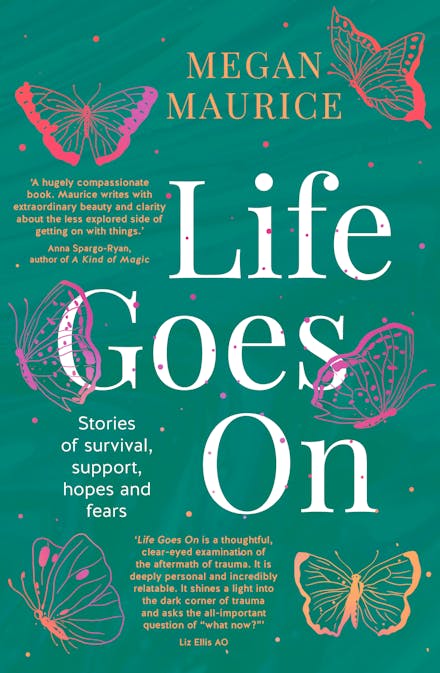
Whether it's cancer, a car accident, grief, a natural disaster or a family tragedy, we all experience trauma, and simply surviving takes everything we have. But what happens after that, when you realise that surviving survival might be harder still? With its combination of personal stories and expert information, Life Goes On shows us how to go on.
Latest news

Q&A with Megan Jacobson
We chat to Aussie YA author Megan about life, death: and TradWife TikTok...

Read an extract from The Waiting Place
Dive into this dazzingly good YA!

Favel Parrett's One for Sorrow Tour
Meet award-winning author Favel Parrett as she tours Australia to promote her new book One for Sorrow

The Richell Prize Shortlist 2026
Announcing the shortlistees of The Richell Prize 2026

Book Club Questions for No One's Looking
Find a book you'll love, get our newsletter
Hachette Australia acknowledges and pays our respects to the past, present and future Traditional Owners and Custodians of Country throughout Australia and recognises the continuation of cultural, spiritual and educational practices of Aboriginal and Torres Strait Islander peoples. Our head office is located on the lands of the Gadigal people of the Eora Nation.

This site is protected by reCAPTCHA and the Google Privacy Policy and Terms of Service apply.
© Hachette Australia, All Rights Reserved · Site by Chook