


Escape to Provence in the highly anticipated historical novel The Artist by Lucy Steeds.
London, 1957
A woman. A painting. The sense of greeting an old friend.
The woman has travelled a long way to stand here, in a cavernous room of the National Gallery. Crowds ebb like shoals of fish around her, heels flitting against the polished wooden floor, but the woman does not move. She stands straight and still, a folded raincoat over one arm.
She does not take her eyes from the painting.
It is a large canvas, wide and tall with an ornate golden frame. The colours are vivid. The paint is thick like glue. She could reach out a hand and run her fingertip over the cragged surface if she wanted, but she does not.
Her eyes shift to a plaque affixed to the wall.
Edouard Tartuffe, 1859–1921
Le Festin (The Feast), 1920
Oil on canvas
The Feast depicts a table laden with food, some half-eaten, some rotting, but nobody present. The colours are characteristic of Tartuffe’s bright, luminous palette, and the painting showcases the distinctive brushwork which earned him the name ‘Master of Light’. Particular skill is shown in the reflections in the wine glasses and the smear of butter on a silver knife. The table is laid for thirteen which has led some to suggest it is an allegory of the Last Supper. The uneaten feast can be seen to represent the futility of decadence after the First World War, as well as lives interrupted and pleasure wasted. The Feast is the only painting to survive the fire that destroyed Tartuffe’s studio in 1920.
A smile flickers across the woman’s face. She remembers the fire. She remembers the stacks of paintings buckling among dancing amber flames. She remembers the acrid smell of smoke and melting varnish. A wall of heat. Paint evaporating into fumes.
She remembers this painting, too. She remembers The Feast cracking down the middle, fire lapping at its edges. She remembers orange tongues eating at the canvas until wine glasses and melon halves and slices of ham were reduced to nothing but dry black curlicues on the studio floor. She remembers the fire swallowing the feast whole.
Part I
The Painter
Saint-Auguste-de-Provence, 1920
JOSEPH
A stranger comes to town. He walks along a dusty road, fields of lavender on one side, a placid green river on the other. The sun beats down on his bare head and he carries only a battered knapsack over one shoulder. He is young, barely twenty, and walks tall and straight like a ballet dancer, or a soldier who has never seen war. The town is a sleepy hamlet in the south of France. The stranger is Joseph Adelaide.
He clutches a letter in his hand. He has read it over and over but it contains only one word:
Venez.
Come.
Beneath that is a signature. The letter is from somebody Joseph has never met but he knows the signature intimately. It is a signature most often found in the corner of paintings. It is scrawled in the corner of Joseph’s favourite painting in the National Gallery, Bathers at Arles. It appears on paintings in gilded frames at Sotheby’s and the Knoedler. And it is at the bottom of a letter addressed to him.
Joseph had been apprehensive about sending his request at first. He had reworked and rewritten it, crossing out his puny phrases and feeble wording. He had gone through draft after draft until one day, after months of agonising, his sister had snatched the letter from his hand and taken it to the post office herself.
There had followed months of silence. Joseph put the letter out of his mind; he had been foolish to think he would get a response. Arrogant, even. He buried his head in his hands whenever he thought of it.
But then . . . this. In early June a single sheet of paper had arrived.
He had not needed the return address to know who the letter was from. He had not needed the cluster of foreign stamps or the blue ink of the French postal service. The signature had told him everything. He had packed his bags that very morning, sent a telegram to his editor to let him know that yes, it was happening, yes, he had received a reply, and yes, he was going. He did not know when he would be back.
Joseph had caught a crowded train to Charing Cross, then another to Dover and talked his way onto a steamer bound for Calais. A further train had taken him to Paris where he had spent an uncomfortable night in a rickety boarding house before catching the morning train to Avignon. It was late when he arrived, too late to go on, and so he took a room in the hostel by the station. The next morning he wandered the pale stone streets, knapsack over his shoulder. There were no trains to where he needed to go next. No public transportation at all. He eventually managed to flag down a trundling milk cart and hitch a ride to Saint-Auguste, where he has just been deposited on the side of the road.
He is dusty. He is sweaty, and nearly blinded by the hot, white light of the Mediterranean sun.
A crinkled woman in the village tobacconist has given him directions: go down the empty road, keeping the river on your left. Go past the tumbledown church until you come to a donkey track. If you reach the caves you have gone too far. Turn left off the road and follow the donkey track. You will see no one. Keep walking past the ruined buildings, and just when you think you have gone the wrong way you will come to an old farmhouse. Good luck.
Joseph looks about himself now, at the dry, shimmering fields and the trees that rise like columns of smoke. He rubs a lavender stalk between finger and thumb, staining them with its tangy scent. He does not know what he will find at the end of this path. His feet are ungainly in his brother’s too-big boots, and he tries to focus on the steady in and out of his breath. He has his letter of introduction: a telegram from his editor, hastily sent to the Paris boarding house where he had tossed and turned. And most importantly, he has that one scribbled word: Come.
He passes what looks like a sheep pen, and beyond that a dilapidated structure that could be a shepherd’s hut. Or an ice store? He knows nothing of life in the countryside. He is used to the horizonless vistas of a grey city, not this fresh expanse of clear air and buttery light. He steps beneath the dappled shadows of peeling plane trees, weaves through a twisted olive grove, and then, finally, he sees it: a low, rambling farmhouse. It is made of soft yellow stones turned golden in the afternoon sun. The roof is encased in a lattice of vines. The windows are small to keep out the heat.
Joseph takes a deep breath and steps up to the front door. Its blue paint is flaking and the handle is browned with rust. He knocks.
No answer.
He knocks again, pressing his ear to the door but there is no sound from within. ‘Hello?’ he calls, his voice dry and crackling, but the only response is the dull hum of crickets, and the steady thump of his heart.
Something twinges in his stomach. He feels glaringly at odds with his surroundings: too pale, too foreign to be here. He takes off his glasses and wipes them on the corner of his shirt. Perhaps this is a sign. The empty road, the deserted house: perhaps it is a warning that he should turn around, hurry back up the lonely path, go home with his tail between his legs.
He has the curious sensation that he is being watched.
Joseph steps back, shielding his eyes and taking in the hazy landscape. Sunlight radiates from the yellow fi elds and dust sticks to the olive trees, dark and fragrant in their arthritic twists. This is a place he knows well, though he has never been here before. He recognises it from paintings of hay bales and wheat fields, from sketches of green, snaking rivers and purple dusks over distant hills.
He shifts the knapsack onto his shoulder and walks around the edge of the house, stumbling over a fallen roof tile. Loose stones are scattered about as if the house is dissolving into the ground. Sun-bleached grass grows right up to the walls, but Joseph notices there are footstep-trodden paths winding this way and that. A wheelbarrow lies rusting in the sun, but its belly is full of freshly cut flowers.
Somebody is here.
Joseph rounds the back of the house and comes to a stone terrace which gives way to a long, undulating field. Down at the bottom he can see a copse of trees and what might be a river, slipping darkly through green bushes.
As Joseph steps onto the terrace, his heart stutters in his chest. There is a man in an old wicker chair. He is leaning back with a cigar in one hand, the index finger of the other resting in a jar of honey. Joseph watches as he takes his finger from the honey and sucks it, slowly, before returning it to the jar. He takes a long drag of the cigar.
Here is the man Joseph has travelled days and miles to see. The man who answered his letter with a single command. The Master. Edouard Tartuffe.
Joseph’s knapsack falls to the ground with a thunk. Tartuffe looks up. He is about sixty or so. Robust, full-faced and wide about the middle, with a frothy grey beard spreading down his front as if he has spilt it. He has one milky eye. The other is quite sharp, but the one he turns on Joseph now is clouded and ghostly.
He removes his finger from the honey. ‘Who’, he asks in thick, gravelly French, ‘are you?’
Joseph steps forward, fumbling for the telegram of introduction in his knapsack. ‘My name is Joseph Adelaide,’ he says hastily, pulling out the sheet of paper from his editor. ‘I am a journalist. I wrote to you several months ago and you did me the kindness of replying.’ Joseph’s French is good but it still feels strange to him, like he is wearing another man’s clothes. ‘You invited me here.’ He holds out the telegram. ‘You invited me here . . . and now I have come.’
-
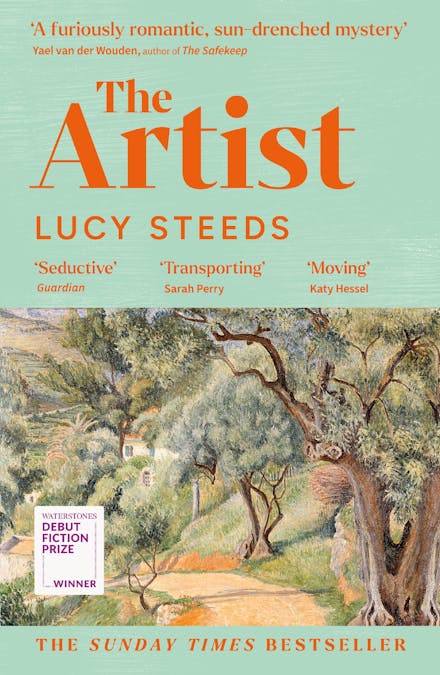
An intense summer of love, lies and the promise of freedom, set in Provence in 1920.


Find a book you'll love, get our newsletter
Hachette Australia acknowledges and pays our respects to the past, present and future Traditional Owners and Custodians of Country throughout Australia and recognises the continuation of cultural, spiritual and educational practices of Aboriginal and Torres Strait Islander peoples. Our head office is located on the lands of the Gadigal people of the Eora Nation.

This site is protected by reCAPTCHA and the Google Privacy Policy and Terms of Service apply.
© Hachette Australia, All Rights Reserved · Site by Chook