


Lane Holland's crime-solving career ended the day he went to prison. Yet one unsolved case continues to haunt him: the disappearance of Matilda Carver two decades ago.
Against the odds, Lane finds a lead - a mysterious farm community where Matilda lived briefly, led by the enigmatic Samuel Karpathy. The farm attracts lost souls. People looking for answers. People hiding from their pasts. People who have nowhere else to go.
But some of those who go to the farm seem to vanish without a trace.
Is it a commune? Is it a cult? Or something far more dangerous?
Start reading to find out for yourself...
His stomach muscles began to quiver, rattling against his already upset stomach. He paused, let his forehead rest on the floor. The rest of his body followed suit without him deciding to do so. ‘That tremble is good,’ the yoga instructor’s voice said. He’ d long forgotten her face, but whatever managed the files of his mind had decided her voice was worth holding on to forever. ‘When we’re anxious, our body tenses up. That tremble forces you to let go of all that trauma.’
He’d been primed like a pump, hadn’t he?
CHAPTER TEN
Lane had his pants halfway up when the door to Sweeney’s side of the cabin swung open. ‘Time to head to the office and juice up your leash,’ Sweeney said, ignoring Lane’s frantic rush to get himself properly clothed.
‘Doesn’t the battery last a week?’
‘They’re on solar here,’ Sweeney said. ‘Between the shitty weather and their system being cobbled together with duct tape and hope, the department thinks it’s too high risk. If the power goes out and your battery runs down before it comes back on, you’ll get a window of opportunity to peace out. So I get an alert as soon as you hit forty-nine per cent.’ He tapped his smartwatch. Sweeney escorted him to the admin building, grumbling under his breath about having an extra work task to do, and hooked Lane up to the charging cable. It was a little over a metre long, giving him a decent amount of freedom to move in the small office.
Lane crossed his fingers, hoping he and Sweeney weren’t about to spend an hour staring at each other in silence while the ankle bracelet charged. To his relief, once Sweeney was satisfied it was charging correctly, he headed for the door, ignoring the cheerful, ‘Goodbye,’ Lane said to his back.
Lane counted to one hundred, just in case Sweeney changed his mind and came back, before stepping forward. Moving carefully – not wanting to accidentally tug the charger loose – he tested how far he could go. The desk, the door and the filing cabinets were all within his range. First he needed to check for a camera. If there was one, it would capture him searching for it, but that would be easier to explain away than getting filmed tossing the room. Someone had left one of the headlamps lying on the edge of the desk. He picked it up and then closed the window blinds. Some light still leaked in around the edges, but it was dark enough for his needs. He looked around for any small points of light that might be a camera.
No lights. He flicked on the headlamp and moved the beam slowly around the room, searching in a grid pattern. First up high in the corners of the ceiling, then across the walls, then over the floor and under the furniture. Not all cameras had a light, but even the tiniest had a lens, and it would reflect the torchlight back at him. Nothing. Satisfied, he put the torch away and turned on the overhead light.
It occurred to him that Karpathy had showed no signs of being protective of this room. This was the second time Lane had been left alone in it, so it was unlikely there was anything sensitive within easy access. The only place Karpathy seemed protective of was the locked door leading to the shed at the other end of the building. Lane tried the computer first. He didn’t know how many guesses at the passcode it would give him before locking him out, so he decided to err on the side of caution and limit himself to three. He knew from watching Karpathy that the first two digits were 66, so he opted for the systematic approach. 6600. 6601. 6602. With one hundred possible combinations and three attempts every four days, he would manage to unlock it before his six months here were up, but there had to be a better way.
He left it, and turned instead to the filing cabinets, tugging on the drawer marked A–C. It didn’t budge. He cast his eyes around the room and found a coffee cup filled with rings of keys. He sifted through and found a pair at the bottom that were the right size and shape for filing cabinets. The key fit perfectly, and he started flipping through employee files, starting from the back. He noted there wasn’t one for Hannah Cudney, but he quickly came to one labelled Carver, Matilda. He pulled Matilda’s file out with shaking hands. He’d been starting to feel like she was a ghost, that nobody would ever admit she’d been here. But here it was: undeniable proof.
Flipping through the file, he found a handwritten application for a farmhand job, listing her experience with fruit picking and livestock handling, but no contact details for references. There was a printout of her days worked, and her hourly wage. Next was a payslip, which matched the calculation of hours worked and money earned. The payslip was dated six months after she was reported missing, and seemed to cover the entire time she had worked at the farm to that date.
There was a photocopy of a cheque made out to cash, and a bank reconciliation showing it had been cashed at an Albury bank the day after it was issued. Something had been written at the bottom of the page, but it was redacted with a black marker. He turned the paper over, hoping whoever originally wrote it had
pressed hard enough to still make it out, but was disappointed. The last page in the file chilled him. It was a printout of Matilda’s Missing Persons profile. So those on the farm had known that the police were looking for her but had done nothing to help. He replaced the file in the drawer and moved down to S–V. Alain Serling’s file was nearly identical to Matilda’s.
A handwritten application form. The time tracker, a cheque issued and bank reconciliation. His cheque was issued and cashed two months after Matilda’s, Lane saw. There were no notes, written or redacted.
There was a copy of his Missing Persons profile.
And one more document. A printed topographical map of the farm. Someone had marked it with an X.
-
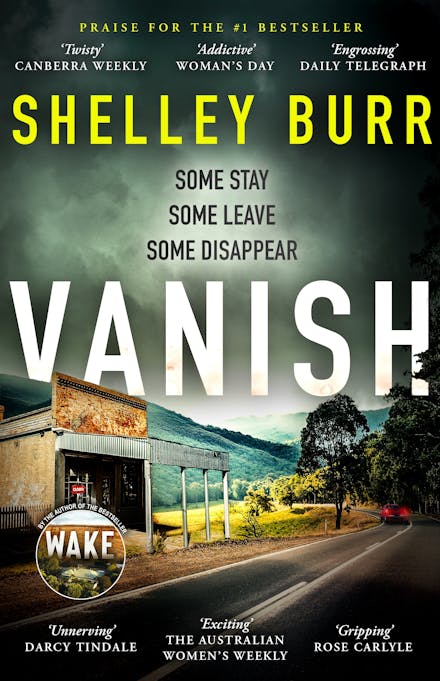
Some stay. Some leave. Some disappear . . . A twisty, sinister and propulsive thriller, VANISH cements award-winning Shelley Burr as one of Australia's bestselling writers.


Find a book you'll love, get our newsletter
Hachette Australia acknowledges and pays our respects to the past, present and future Traditional Owners and Custodians of Country throughout Australia and recognises the continuation of cultural, spiritual and educational practices of Aboriginal and Torres Strait Islander peoples. Our head office is located on the lands of the Gadigal people of the Eora Nation.

This site is protected by reCAPTCHA and the Google Privacy Policy and Terms of Service apply.
© Hachette Australia, All Rights Reserved · Site by Chook