


Read an extract of The Wedding People by Alison Espach, the hilarious and moving million-copy bestseller.
“Next?” the front desk woman calls.
It takes a moment for Phoebe to realize it’s her turn. She sees High Bun and Neck Pillow already walking into the elevator. She takes the bag, thanks the bride, and walks toward the front desk.
“You must be here for the wedding, too?” the woman asks. Her name is Pauline.
“No,” Phoebe admits. “I’m not.”
“Oh,” Pauline says. She sounds disappointed. Confused, actually. Her eyes flicker to the bride in the distance. “I thought everybody here was here for the wedding.”
“I am definitely not here for the wedding. But I made a reservation this morning.”
“Oh, I believe you,” Pauline says, typing as she speaks. “I just think that someone here has made a very big mistake. It might have even been me! You’ll have to excuse us, we’re a little understaffed since Covid.”
Phoebe nods. “Labor shortage.”
“Exactly,” Pauline says. “Okay, what’s your name?”
“Phoebe Stone.”
This is true. This is her name, the name she has come to think of as hers. Yet it feels like she’s lying when she says it now, because it’s her husband’s family’s name. Whenever she hears herself say it, it somehow pushes her outside of her body. It makes her see herself from up above like a bird, the way the wedding people must see her, and she’s sure from up there, they can spot the one thing that is ugly about her, too: her hair. Something should be done about that hair. She completely forgot to comb it this morning.
“Here you are,” Pauline says. She is so focused now on giving quality service she does not even look up when one of the wedding people walks through the doors and slips on the floor behind Phoebe.
“Uncle Jim! Oh my God! Are you okay?” the bride shouts.
Uncle Jim is not okay. He is on the floor, yelling something about his ankle, and also the floor, which is a terrible floor, he says, not to mention, total bullshit. The men in burgundy gather around him and start apologizing to him about the floor, which yes, yes, they agree is the worst floor, even though Phoebe can see it’s some kind of Italian marble.
“There it is,” Pauline says. Pauline is a hero. “You’re in the Roaring Twenties.”
“Is each room a decade?” Phoebe asks. She pictures each room having its own hairstyle. Its own war. Its own set of stock market triumphs and failures. Its own definition of feminism.
“You know, I don’t actually know what all the themes are!” Pauline says. “I’m new. They seem kind of random to me. But that’s a great question.”
She opens the drawer, searches for the right key.
“It’s our penthouse suite,” she says. “The only one with a proper view of the ocean.”
It feels practiced, as if Pauline whispers something to each guest to make them feel special. It’s our only room with a desk from the Vanderbilts’ family home. It’s our only room with an infinite supply of toilet paper.
“Wonderful,” Phoebe says.
“So what brings you to the Cornwall Inn?”
Even though she knew this question was coming, Phoebe is startled by it. When she imagined herself here, she didn’t imagine herself having to speak to anybody. She is, simply, out of practice.
“This is my happy place,” Phoebe blurts out. It’s not the entire truth, but it’s not a lie.
“Oh, so you’ve stayed with us before?” Pauline asks.
“No,” Phoebe says.
Two years ago, Phoebe saw the hotel advertised in some magazine, the kind she only ever read while waiting in the fertility clinic. She looked at the pictures of the Victorian canopy bed, overlooking the ocean, and she thought, Who actually plans their vacations by looking through a travel magazine? She felt angry at these people, not that she knew anybody who did things like that. Yet days later, when her therapist asked her to close her eyes and describe her happy place, she pictured herself on that canopy bed because she could only imagine herself happy in a place she had never been, a bed she had never slept in.
“Well, this is a happy place, indeed,” Pauline says.
Phoebe picks up the key. It’s already been too much conversation. Too much pretending to be normal, and she is not paying eight hundred dollars just to stay here and pretend to be normal. She could have easily done that at home. She feels herself grow weary, but Pauline has so many more questions. Would she like to add a spa package? Would she like to book a visit with their in- house tarot reader? Would she like a normal pillow or a coconut pillow?
“What’s a coconut pillow?” Phoebe asks.
“A pillow,” Pauline says, “with coconut in it.”
“Are pillows better that way?” she asks. “With coconut inside them?”
That’s what her husband would have asked. A bad habit of hers, a product of being married for a decade— always imagining what her husband might say. Even when he’s not around. Especially when he’s not around. Phoebe didn’t think she’d end up being a woman like this. But if the last few years have taught her anything, it’s that you really can’t ever know who you are going to become.
“Pillows are much better that way,” Pauline says. “Trust me. We’ll have one sent right up.”
Phoebe walks into the elevator and feels relief when the doors start to close. Finally, to be getting away from the wedding people. To be doing something for a change. To have a key to a place that is not her house.
“Hold the elevator!” a woman calls out.
Phoebe knows it’s the bride before she sees her. She yells like she deserves this elevator. But nobody deserves anything. Not even the bride. Phoebe presses the button to close the doors, but the bride slides a hand between them. They don’t bounce open like they’re supposed to, maybe because the Cornwall was built in 1864. An old hotel has no mercy, not even for the bride.
“Fuck!” the bride shouts.
“Oh, God!” Phoebe says. She pries the doors back open, then stares at the bride’s hand in disbelief. “You’re bleeding.”
The bride holds up the gash across the back of her knuckles like a child and takes the tissue Phoebe offers without saying thank you. Phoebe presses the button, and the doors close again. The women don’t say anything as the bride politely bleeds into the tissue and they begin to ascend. Phoebe hears the bride try to steady her breath, watches the tissue darken.
“I’m really sorry,” Phoebe says. “I didn’t realize that would happen.”
“Oh, I’m sure it’ll be fine,” the bride struggles to say. She clears her throat. “So, are you in Gary’s family?”
“No,” Phoebe says.
“Are you in my family?”
“You don’t know who’s in your own family?” Phoebe asks. The question makes Phoebe want to laugh, and it’s a strange feeling. The first time she has wanted to laugh in months. Years maybe. Because how does the bride not know her own family? Phoebe knew everybody in her family. She had no choice. It was so small. Just Phoebe and her father, tiny enough to fit inside his old fishing cabin.
“I have a very large family,” the bride says, like it’s a big problem.
“Well, I’m not in your family,” Phoebe clarifies.
“But you have to be in one of our families.”
“No,” Phoebe says. “I’m not in any family.”
It had been a crushing realization, one that started slowly after the divorce, and got stronger with each passing holiday, until she woke up this morning to such a quiet house, she finally understood what it meant to have no family. She understood it would always be like this— just her, in bed, alone. No longer even the sound of her cat, Harry, meowing at the door.
“But everybody is here for the wedding. I made sure of it.” The bride eyes the gift bag in Phoebe’s hands, confused. “This has to be some kind of mistake.”
The bride says it as if Phoebe is the big nightmare she has always been dreading. Phoebe is something going wrong at a time when nothing is supposed to go wrong. Because every little thing during a wedding has the power to feel like an omen— like the high winds through the park that flipped over the paper plates and sent a chill down Phoebe’s spine on her own wedding day. We should have gotten real plates, she thought, something with weight and substance.
“There’s no mistake,” Phoebe says.
This is Phoebe’s happy place. The place Phoebe has chosen out of all the possible places. How dare the bride make Phoebe feel like she’s not supposed to be here.
“But if you’re not here for the wedding, then what are you here for?” the bride asks in a much lower pitch, as if her real voice has finally emerged. Because now in this private space with a person not attending the wedding, the bride doesn’t have to be the bride. She can speak however she wants. And so can Phoebe. Phoebe is not High Bun or Neck Pillow. She is nobody, and the only good thing about being nobody is that she can now say whatever the fuck she wants. Even to the bride.
“I’m here to kill myself,” Phoebe says.
She says it without drama or emotion, as if it’s just a fact. Because that’s what it is. She waits for the truth of it to stun the bride into an awkward silence, but the bride only looks confused.
“Um, what did you just say?” the bride asks.
“I said, I’m here to kill myself,” Phoebe repeats, more firmly this time. It feels good to say it out loud. If she can’t say it aloud, then she probably won’t be able to do it. And she has to do it. She has decided. She has come all this way. She feels relief as the doors begin to open, but the bride presses the button to close them.
“No,” the bride says.
“No?” Phoebe asks.
“No. You definitely cannot kill yourself. This is my wedding week.”
“Your wedding is a week?”
“Well, like, six days, if you want to be technical about it.”
“That’s a . . . long wedding.”
Phoebe’s wedding was a single night. She had tried not to make a big deal out of it. And why? It seems silly now, to have not celebrated something good when she had the chance. But Phoebe and her husband were a year out of graduate school, trained to live on a stipend with a cheap bottle of wine and a nice tree in the distance. And a wedding was such a spectacle, Phoebe thought. Every time she ordered flowers or sampled another piece of cake or told her friends how happy she was, she got this horrible feeling that she was bragging.
“A week is actually pretty standard now,” the bride says with a tone that makes Phoebe feel old. “And people are coming a long way to be here.”
But Phoebe doesn’t care.
“This is the most important week of my life,” the bride pleads.
“Same,” Phoebe says.
Phoebe presses for the doors to open, but the bride closes them again, and it makes Phoebe angry, the way she gets only when she’s stuck in traffic on the way to work. All those taillights ahead made her want to scream, and yet she never did, not even in the privacy of her own car. She was not a screamer. Not the kind of woman who ever made demands of the world, did not expect the streets to clear just because she was in a rush. She was not like the bride, who stands so entitled in her glittering sash like she’s the only bride to have ever existed. It makes Phoebe want to rip off the sash, whip out her own wedding photo, show her that she had been a bride once, and brides can become anything. Even Phoebe.
But then the bloody tissue falls to the ground. As the bride picks it up, she lets out a half sob, then looks at Phoebe as though her entire life has already been ruined.
“Please don’t do this,” the bride begs, and it gives Phoebe that feeling again, as if she knows her, like the bride is asking from one cousin to another.
“I’ll be very quiet,” Phoebe promises. “I mean, I might put on some light jazz in the background, but you won’t hear it.”
“Are you joking? Is this a sick prank or something? Did Jim put you up to this?”
From her purse, Phoebe pulls out her ancient Discman and a CD titled Sax for Lovers. One of the only things she brought from home. From the first night of their honeymoon in the Ozarks. A small motel on the side of a canyon with a heart- shaped hot tub that made the whole room humid. Her husband found the CD in the stereo. Sax for Lovers, he read aloud, and they laughed and laughed. Well, put it on, lover, she said, and they danced until they undressed each other.
“Oh my God,” the bride says. “You’re serious. You’re going to do it here? In your room? When?”
“Tonight,” Phoebe says. “At sunset.”
She is going to smoke a cigarette on the balcony. She is going to order room service. Have a nice meal while looking out at the water. Eat an elaborate dessert. Listen to the CD. Take a bottle of her cat’s painkillers and fall asleep in the large king- sized canopy bed as the sun goes down. It is going to be quick, beautiful, and entirely bloodless, because Phoebe refuses to make the staff clean like her friend Mia cleaned after her husband Tom slit his wrists. That’s just selfish, Phoebe’s husband said when they heard, and Phoebe agreed, because Tom survived. Because it felt important for a husband and wife to agree on something like that. But also because Phoebe is a tidy person, afflicted by the belief that each book has its rightful place on the shelf and blood should always be inside our bodies, even after death, especially after death, and how awful for Mia, to have to kneel down and scrub her husband’s blood out of the grout.
“There will be no mess,” Phoebe promises.
“No,” the bride says firmly. “Absolutely not. This can’t happen. This can’t be real.”
But her wound is a red circle that keeps expanding. The bride looks at it and says, “How could you do this to me?”
Is Phoebe really doing anything to her, though? If it’s not Phoebe, something else will ruin it. That’s how weddings go. That’s how life goes. It’s always one thing after another. Time the bride learns.
“Believe it or not, this actually has nothing to do with you,” Phoebe says.
“Of course it does!” the bride says. “This is my wedding! I’ve been planning this my entire life!”
“I’ve been planning this my entire life.”
-
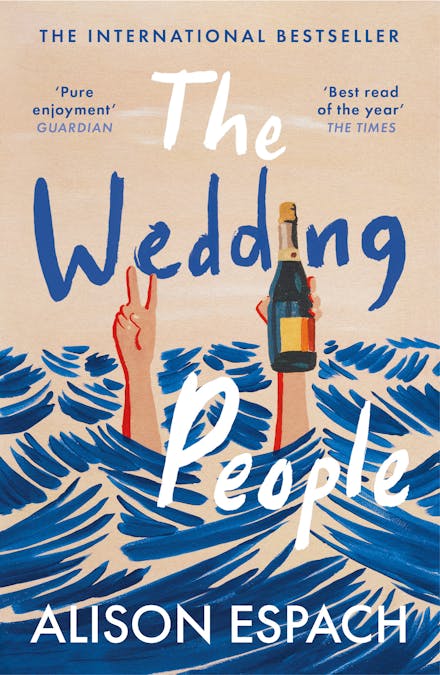
The smash-hit Read With Jenna pick that has sold over a million copies worldwide, a hilarious and heartbreaking novel about a woman who checks in to a glamorous hotel at the lowest point in her life, only to find herself swept into a stranger's wedding and forever changed by her entanglement in their dysfunctional family


Find a book you'll love, get our newsletter
Hachette Australia acknowledges and pays our respects to the past, present and future Traditional Owners and Custodians of Country throughout Australia and recognises the continuation of cultural, spiritual and educational practices of Aboriginal and Torres Strait Islander peoples. Our head office is located on the lands of the Gadigal people of the Eora Nation.

This site is protected by reCAPTCHA and the Google Privacy Policy and Terms of Service apply.
© Hachette Australia, All Rights Reserved · Site by Chook