


Read 'The Great Walk' from Inga Simpson's upcoming collection, Once We Were Wildlife.
The path wound through beech forest. What light beamed through the canopy was sidelong, all russets and greens, and somewhere a tomtit pair called to each other. Andi settled into a good rhythm, using her walking poles to propel her forwards over flat ground, pick her way around tree roots and muddy patches, and slow her progress on downhill sections.
When she reached the lake the water was mirror-still, smooth round stones glistening at the edge. Tree-crowded islands beckoned, like stepping stones to the other side, and the snow-capped mountains beyond. There were many footprints across the sand but none of them were Chris’s size fourteen Scarpas.
He was doing one of their favourite Great Walks, and she was meeting him to walk the last two sections together. They had done the whole thing half-a-dozen times over the years, but she was no longer confident on the climbs and scrambles; her legs weren’t as strong or as steady as they used to be.
She hurried through the last section of forest, and past the group of ancient beech, trunks alight, leaning towards the water. Someone had lit a fire recently, from the driftwood that washed ashore, and a kayak had been dragged up onto the sand. But Chris was not there.
There was a can of beans and a packet of instant noodles on the table inside the hut, which she would not be using. They prided themselves on cooking their own meals and dehydrating them. She was carrying their food for the two days, to lighten Chris’s load. She had packed a little bladder of local pinot, too, as a surprise.
She eased out of her pack and propped it against the wall. Her back was aching and her knees and hips sore. But it was the best she had felt for months: muscles warm, blood pumping and lungs full of oxygen.
But where was Chris? Had they even discussed which hut? Her hearing wasn’t the best, and sometimes she didn’t pay as much attention as she should. But they always went to Shallow Hut. It was their favourite. For the reflections, the birds, the lap-lapping of lake water, and those grand mountains watching over them, that they were now too old to climb.
There was another hut half an hour away, but it was much bigger, much more likely to contain other walkers. More often than not they had had Shallow Hut to themselves. There was a history.
But perhaps something had happened: a blister or a cramp. The other hut was closer to the trail, at the end of a long, hard section. Andi gauged the light. There was still time to walk there and check. She could outpace most people without her pack, even now. She slipped her head torch and a mini peanut slab into her fleece pocket. She and Chris could walk back together in the dark. They could do this trail in their sleep.
•
Andi followed the winding path back through beech and across the bog and back to the main path. The forest was dark now, here and there fleeting shadows. Robins and tomtits and sneaking mammals. Pale timber stoat traps seemed to glow beside the path. Stoat coffins she called them, or weasel boxes. She pushed on uphill. The light was going fast, the days so short down south in winter.
When she reached the main hut there were five packs hanging from hooks on the outside wall but none of them were Chris’s. She pushed the door open with a bang. Five young women rehydrating their individual meals on camp stoves, turned to stare.
‘Have you seen my husband?’ Andi said. ‘Tall, thin. Round silver spectacles. A green pack. Well-worn.’ She was out of breath, and her chest was hurting with all the hurrying and worrying.
They shook their heads.
‘What about on the trail? Today or yesterday?’
A woman with kind eyes and a blonde plait stood. ‘We haven’t seen him. Was he walking on his own?’
The woman had an Australian accent and was wearing an aqua Mont fleece.
‘He was,’ she said. ‘But we were supposed to meet at Shallow Hut.’
‘Have you tried messaging him?’
She shook her head. ‘I didn’t bring my phone.’
The woman glanced down at the others. They didn’t want her there, though there was room for forty people at a pinch.
‘Is he carrying a PLB?’
‘He is,’ Andi said. Their daughter Margi had insisted on that, buying them one as a Christmas present. She had made herself their emergency contact person.
‘That’s good,’ the woman said. ‘He’s probably just running late. There was a bit of snow up top the last few nights.’
It was almost dark outside. She hadn’t really considered the possibility of walking back to Shallow Hut on her own.
‘Would you like a cup of soup?’ the Mont woman said.
‘I should go back,’ Andi said. ‘Perhaps he’s there now.’
She struggled with the door and stumbled on the steps but righted herself. She had been foolish. She should have stayed where she was and waited. That was their one rule, whether walking or travelling. And it worked. Like the time they were in Rome, which was way too crazy a city for their country compass. That was well before mobile phones and Goggle Maps, as Chris liked to call it. He had wanted to go back to the Jewish quarter and she had wanted to go to the Pantheon. They had agreed to meet for a drink at their favourite bar, near the little place where they were staying, at dusk. But Chris hadn’t shown up then either. The barman was handsome and flirtatious, bringing her olives and almonds, and a second drink on the house, which soothed her irritation. It was their anniversary, after all. Eventually Chris did appear, carrying something wrapped in brown paper. It was an antique, and there had been some paperwork, he said. They still had the piece on the sideboard, a bronze falcon in flight.
She adjusted the torch beam to light the path a little ahead of her rather than at her feet. The dark was less oppressive that way. Perhaps he had walked past the big hut while she was inside and was on the path in front of her. He would be tired and perhaps she could catch up to him.
She wasn’t always making the best decisions lately. She had put the shopping down behind the car in town and driven off without putting it in the back. And she had subscribed to more outdoor magazines than they really needed, including the same one twice. And leaving her phone at home, well, that hadn’t been clever. It wasn’t an accident, though. She didn’t want it ringing and pinging while she was on the trail. Their daughters, though alleged adults with children of their own, were always wanting something. Money or advice or babysitting, which she didn’t mind but it did mean they couldn’t always get away as much as they would like.
Neither daughter approved of them hiking, let alone camping, at their age. But that was their way of life, always had been. And they were still stronger and fitter than either daughter or their city-bred husbands.
The beech cast long shadows, moss swallowed stumps and logs and goodness knows what. Here and there deep subsidences had opened up, which would be all too easy to fall into. She thought of her walking poles, leaning against the wall of the hut, as she stumbled over yet another gnarled tangle of tree roots. Another mistake. She was watching for the turn-off, her chest tight with anxiety. It was hard to take a proper breath. The dark seemed to gather in, despite her head torch, and she couldn’t make her legs and feet move as they should. She staggered, and the ground came rushing up to meet her.
•
When she reached their cabin, it was daylight. And all her things were gone. Even her beat-up old poles. In all the history of their walking, at home and all over the world, no one had ever stolen anything. It was against some unwritten code. She peered out the door, squinting against the glare of the sun on the water and fresh snow capping the mountains. Everything seemed so bright and sharp, its detail, colour and sound. Birdsong was more melodious, as if the high range of her hearing had been returned.
There were many footsteps leading to the steps of the cabin, and just as many leading away. One set resembled Chris’s but she couldn’t be sure, with so many others trampled over the top.
‘Chris?’ she said, from the doorway.
Perhaps he had hidden her pack. He had never really been one for pranks but his sense of humour had changed a little lately. Deteriorated into dad jokes, she thought but didn’t say. The girls did, though, rolling their eyes.
But there was no answer. And she had no sense of him close by. Those girls could have stolen her things. But they wouldn’t want her tired, outdated kit.
A fantail flit-flirted around her head, flashing his tail, bright white, again and again, like some sort of flag.
‘Hello, handsome,’ she said. ‘Did you see what happened to my pack?’
But Mr Fantail did not answer.
She had no choice but to head back to the trailhead, where she had begun. Someone there would have a phone and the shuttle bus would come along again eventually. She would find out what had happened to Chris and where he was. A hospital somewhere probably. And one of their daughters, most likely Margi, would have flown over but wouldn’t be able to resist saying, ‘Told you so.’
•
The ancient beech were less judgemental. Their lichen-covered trunks were warm and forgiving, veiled by fog. The forest floor all ferns and fresh saplings coming on. The river rushed by below, so comforting. And overhead the heavy flap and whir of a pigeon. The path was flat cushioned with tiny beech leaves. She could see out to the farmland across the river and the mountains beyond. The ever-present falcons soaring. That’s all that mattered. There was a freedom to walking without possessions (though she had been fond of her backpack, for the history it told, and a few quality pieces of kit that would be hard to replace now, like her old Jetboil stove). She was free to soak in all the details. The little clearing where a tree had come down, bathing those left behind in light, as if on a forest stage. And the fungi forests and nurse logs, the thick moss carpeting almost everything in luxurious green.
She set a good pace. Not top speed, for she didn’t like to rush any walk, but fourth gear, because she wanted to get where she was going. Steady was how Chris described it. It described her too, she supposed, though she liked to upset the applecart every now and then. No one likes to be too predictable.
There were no other walkers, which was strange. Or perhaps not, since it was mid-week and mid-winter. Tomtits flitted across the path, as light and agile as she felt. At the last stoat coffin before the trail dropped down to the great suspension bridge crossing the river, she stopped to look out. A sign warned about not approaching the edge, with all the earth washed away beneath. But it was so charming: a bonsai garden of beech and fern and moss and a South Island robin perching just so on a mossy stump.
‘Hello,’ she said.
She looked down at the blue-green river rushing far below, deep and wide, flaring out to pebble beds and flax. It was hard to admit, but this would probably be the last time they did an overnight walk. Perhaps the last time they travelled to this beautiful mountainous country. ‘Aotearoa,’ she said. Known in their household as Middle Earth. Both were true.
She scuffed up the ground with her boot and the robin landed there, tapping his fine foot to entice grubs to come up out of the soil.
‘Aren’t you just perfect,’ she said.
•
She was trying again to reach the trailhead. The mist was thick, creeping through the trees, but it wasn’t as if she could get lost. The path was wide and well-marked with orange triangles on one direction, red in the other. Even if unmarked, she had only to keep the river on her right. And yet something always stopped her from walking downhill to the river. The robin, following after her feet. Or a weasel trapped in the stoat coffin. Something always seemed to distract her and turn her around, or reset the clock somehow. It was like one of those dreams where she was trying to reach the airport but encountered obstacle after obstacle. Or trying to get Chris on the phone but she kept losing it or picking up some strange phone that she couldn’t operate or didn’t contain his number – which, despite all the years, she still didn’t know by heart. There was no need. Not in the waking world.
She couldn’t get back to the big hut either, where the girls had been. Something always happened on the approach to the spot where she had fallen over, to turn her around. And Shallow Hut had been closed, the door boarded over, as if to keep her out.
Two young men ran past in bright shorts and T-shirts, talking in loud voices about markets and margins. Andi smiled and said hello, hoping for some sort of exchange, a little help getting to the shuttle stop, but they didn’t even acknowledge her. That was one of the worst things about getting older, becoming invisible, irrelevant.
•
Andi stopped at the cairn, a neat pile of river stones beside the path, near where she had tripped. Some were speckled like eggs, others striped like tigers, in colours ranging from dark green to pale pink. Someone had gone to particular trouble to collect flat-sided stones in ever-decreasing sizes, and carry them to this spot, on the rise towards the big hut. It had been constructed with great care, like a sculpture, and the topmost stone somewhat resembled a heart.
She hesitated a moment before kicking it over, sending stones clattering in all directions. They didn’t believe in cairns, unless they were way markers on an alpine trail, so you didn’t lose your way in snow. Otherwise, stones should be left where they were. It was an increasing irritation on their walks. Like on the shores of Tasman Lake, that blue dream, where people insisted on stacking stones on the shoreline as foreground for their photos, as if the dark rocks against the white icebergs and turquoise water did not offer a sufficient composition. Chris always sent those cairns back to the water with a precise kick, making a great splash that reverberated outwards.
•
She slept on mossy beds, surrounded by ferns and beech. There was one particular spot near a stream that seemed fitted to her body: soft hollows for her hips and support for her neck. With her thermals and waterproofs, she didn’t feel the cold or damp.
The great flocks of chattering kākāriki were a surprise, both red-crowned and yellow, sometimes even orange, reminding her of the parakeets from home. And kākā high in the canopy, with their cacophony of calls. They were good company. And the kiwi at dusk, loping along as if they’d just left the Jurassic.
Less welcome were the slinky stoats, weasels and ferrets that seemed to congregate around the traps. They chased but never seemed to catch the rats, who disappeared into the fern.
When she first saw a moa, like a giant emu towering above the understorey, she was sure she was losing her mind. But their deep footprints in the mud were real. The next time she just stopped to watch in wonder as one passed, as she always did, at whatever gifts the natural world offered. A female, she thought, from the larger size. Despite the moa’s turning head and all-seeing eye, she felt no fear, only sadness. Sometimes they ran as if pursued, though she never saw the pursuers. When she found a feather, she tucked it in her pocket as proof.
Time had slowed so much she found she could understand the trees’ way of thinking. When the sun was on their trunks they whispered in long song-like sentences, to each other, their fungal networks and the creatures around them. Not to remark on the weather, as she had expected, but to try to convey the subtleties of their feelings. When they addressed her, it was encouraging, as if trying to nudge her towards something.
When it snowed, which wasn’t often, she sheltered in the deep depressions in the ground, covering herself with fern fronds and branches the beech had dropped. If she slept, she didn’t dream.
•
An old man squatted beside the path, putting the finishing touches on another damn cairn. He heaved himself up to his full height on a single walking pole, still gazing at the pile of stones, as she hurried towards him. The man was humming a song she knew: year after year. It had been the final song at the Pink Floyd concert in London, when they first took acid. I am here, she tried to say. But the words stuck in her throat.
The man turned, blinked, and pushed his glasses up his nose. ‘Andi?’
‘But you hate cairns.’
‘Trying to get your attention, I guess.’
‘They did that,’ she said.
‘I’m sorry I wasn’t there,’ he said. His voice was all choked up, the way it got now when he was emotional.
‘What happened?’
‘I broke my ankle,’ he said. ‘Made it all the way across the pass and then rolled my foot on a stone coming down. It got jammed. Had to set off the PLB, get airlifted out. All very embarrassing.’
‘I heard a chopper, when I got off the bus.’
‘That was me,’ he said. ‘I tried to call. You didn’t take your phone?’
‘I know. So stupid.’ She looked down at his feet. ‘Left or right?’
‘Left,’ he said. ‘It aches, but I can get around. No more Great Walks, though, the specialist says.’
Andi frowned. ‘It’s healed already? Why didn’t you come? I’ve been trying to walk out, but I just can’t get back to the trailhead.
His eyes filled with tears. ‘Andi, I miss you. Every day. So much.’
‘Why can’t we just go home?’
‘My love,’ he said, ‘it’s been three years.’
‘The cairns,’ she said.
‘I came over every anniversary.’
‘You flew by yourself!’
‘I wore the stockings. And I thought, if I went, well, I’d be with you.’
‘I’m not …’ But of course she was. Like the moa. Already, when she looked down at her hands, all liver-spotted and wrinkled, they seemed less solid.
‘You had a stroke,’ he said.
‘Oh.’
‘I wish I could have made it to our hut, like we planned.’
‘I’m sorry I didn’t wait. Like I should have.’
‘It doesn’t matter now.’
‘How are the girls?’ Andi said.
‘They miss you, too. Lyndal took it very hard. But they’re well. Believe it or not, they’ve both started walking again. And our grandchildren are growing up fast. Little Zac is reading on his own. He just loves animals.’
‘Oh.’ She could picture Zac’s chubby hands holding a book. ‘I would have loved to read to him. And Jade. Share all this.’ She gestured at the forest.
‘I know,’ he says.
She watches his face shift. ‘What is it?’
‘You need to let go.’
‘Have you met someone else?’
‘Don’t be silly,’ he said. ‘As if. I’d just like a little more time with them, without being so … mournful.’
‘I guess I can’t hang out with the stoats and weasels forever,’ she said.
‘What?’
Andi shakes her head. Her hair has curled, like lichen, floating around her. She can hear the trees murmuring, the tiny steps of beetles. ‘There were moa here,’ she said.
‘Really?’
‘Say goodbye to me properly? It was so awful not being able to say goodbye.’
She moves into his arms, still comforting, still warm. And he holds her.
‘We had such a good life together,’ Chris said. ‘Thank you.’
‘We did, didn’t we,’ she said. It was so much to let go of. ‘Hold me until I’m gone?’
‘I’ll always love you,’ he said. ‘And I’ll see you soon. Somewhere down the track.’
'The Great Walk' is a short story from Inga Simpson's upcoming collection, Once We Were Wildlife, out 2026.
-
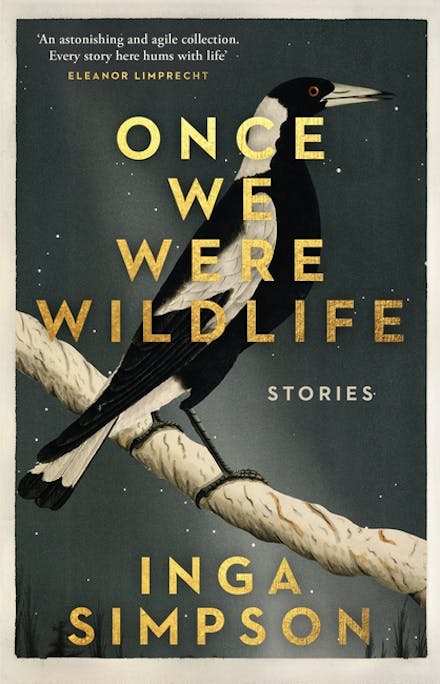
A tender, luminous collection of interconnected tales that explore love, longing and the wilderness - both within and around us.
Latest news

Read an extract from The Waiting Place
Dive into this dazzingly good YA!

Favel Parrett's One for Sorrow Tour
Meet award-winning author Favel Parrett as she tours Australia to promote her new book One for Sorrow

The Richell Prize Shortlist 2026
Announcing the shortlistees of The Richell Prize 2026

Book Club Questions for No One's Looking

Hachette Haunts
Our Halloween reading guide!
Find a book you'll love, get our newsletter
Hachette Australia acknowledges and pays our respects to the past, present and future Traditional Owners and Custodians of Country throughout Australia and recognises the continuation of cultural, spiritual and educational practices of Aboriginal and Torres Strait Islander peoples. Our head office is located on the lands of the Gadigal people of the Eora Nation.

This site is protected by reCAPTCHA and the Google Privacy Policy and Terms of Service apply.
© Hachette Australia, All Rights Reserved · Site by Chook