


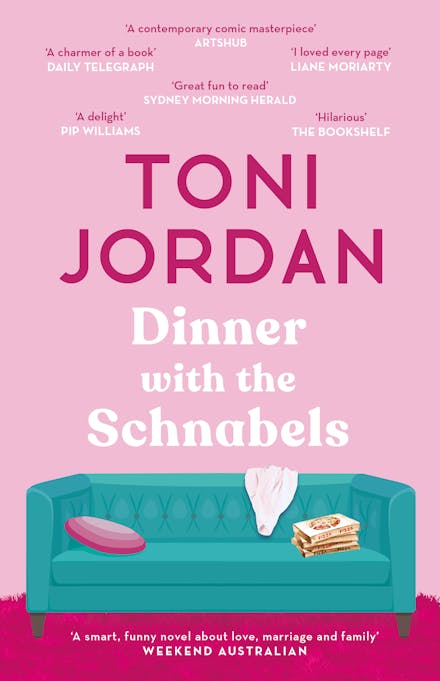
Start reading Dinner with the Schnabels
At first glance, Simon Larsen looked like a man adrift. The hunch in his shoulders, the five-day stubble. He wore a stained hoodie and the trackpants stretched over his waist had seen better days. He was tallish without being quite tall, and beefy without being exactly fat. His eyes, once a sharp blue, were watery and faded with pouches underneath, like small, hairless caterpillars napping. His hair, already silver, was scruffy and his face was puffy and grey. He seemed aimless. That would be an understandable assumption, from the look of him. But if you thought that, you’d be wrong. Okay, he might not have a burning goal that ignited his energy and imagination and saw him leaping out of bed in the morning before the alarm. He’d had those in the past, yes. He was once driven and striving; he was once a person who made plans. That past Simon was someone he could barely recognise. But right now, there was something he did absolutely need to achieve. He needed to landscape Naveen Patel’s backyard. This was not the kind of goal that poets immortalised inverse. It was unlikely to inspire a movie starring Steve Carell as Simon. But the situation was urgent. If Simon fixed Naveen’s backyard, disaster would be averted. And also – and here was the real motivating factor, he admitted – Tansy would get off his back. His mother-in-law, Gloria, would get off his back, his sister-in-law, Kylie, would get off his back, his brother-in-law, Nick, would get off his back. His wife and her entire family would get off his back if he fixed Naveen’s backyard. And once the backyard was fixed, Naveen would pay him. To be honest, they really needed the money. All of this was incredibly motivating for Simon. See? He was a man with a goal. If he did this job by Saturday, he could be back to his normal life by Sunday. And yet. Right now, it was Monday morning. Early. Time was ticking. Simon had only one week to landscape Naveen’s backyard, but he was not there, tilling and shovelling and planting. He was at Southern Cross Station with his wife, Tansy, waiting for a train. Tansy was an apple-cheeked woman with tawny-blonde, shoulder-length hair and a dusting of freckles across her nose that looked like they’d been applied with a paintbrush. Her face was heartshaped. She looked like a milkmaid from a fairy story, like someone who always drank eight glasses of water and slept eight hours every night. Simon still thought she was the most beautiful woman he’d ever seen. They’d been sitting in the cafe at the station for all of three minutes when Tansy said she had to make a call. Had to. She fished her phone from the little pocket on the outside of her tan leather tote where it lived, snug as a Chihuahua, then she pressed the screen. ‘It’s me,’ she said. ‘The train’s not in yet.’ Was a cafe inside a train station actually a cafe? It was more a food court sort of arrangement in this barn of a station. At this ridiculous hour, the takeaway-coffee line snaked along the glass cabinet of carrot cake and wraps all the way past the sushi place, but the seats were empty except for those occupied by Tansy and himself. The voice on the other end of Tansy’s call was loud but indistinguishable. Tansy uh-huhed and mhmed and gotchaed and nodded like a Russian sleeper agent receiving a coded briefing. Finally she hung up without saying goodbye. ‘Was that Kylie?’ Simon asked. ‘Did you just call Kylie again?’ ‘Of course it was Kylie,’ Tansy said as she finished her coffee. ‘Who else did you think I would call?’ Several possibilities had crossed Simon’s mind. Perhaps this urgent call was something to do with work: perhaps nervous owners of a house Tansy was trying to list or a tenant who’d woken up to find they had no hot water. Or perhaps she’d called Edwina Chee just to check the kids were okay, that Lachie had his library bag and Mia had her sports gear. Simon knew the kids had those things because he’d packed them himself. It wasn’t every day that the kids were dropped at the Chees’ to go to school with the Chee children, so it would be natural that Tansy wanted to check in. How ludicrous, he thought. Of course she would call Kylie. He pressed his lips together. The twelve years that Simon had been married to Tansy was long enough to gain some basic understanding of when to shut up. Simon was proud of knowing this. If he was in the Marriage Boy Scouts, he’d have a badge sewn onto his uncomfortably paramilitary shirt that said Discretion is the better part of valour. The less said, the better. There’s no need to keep going on and on about something; part of the secret of a happy marriage was don’t sweat the small stuff. Simon knew how to let things go. ‘You just called Kylie from the car,’ Simon said. ‘It’s the least I can do.’ Tansy made a sad face. Simon opened his mouth to say something that even now he knew he’d soon regret, when Tansy’s phone rang. She held up one finger to him, then answered, ‘Tansy Larsen.’ Then she winked at him, which would have made more sense if she hadn’t been Tansy Larsen. ‘Not yet,’ she said into the phone. This time the voice on the other end sounded like someone who kept a supply of helium balloons at the ready, just in case they needed to give ransom delivery instructions at short notice. ‘Relax,’ she said. ‘We’re going to blend in to the crowd. She’ll never even notice us.’ And then she laughed, and looked at Simon and made a kissy face. Then she sang the beginning of the James Bond theme – doo doodoodoodoo doo doo doo – and listened for a while longer and when she hung up, laughing, she looked at Simon. ‘What?’ she said to him. ‘Let me guess. That was Nick.’ ‘Of course it was Nick,’ she said. ‘Who else would it be? He says hi, by the way.’ ‘If only he was here at the station. At 7 am. Like we are. Then he could have said hi in person.’ ‘They both feel bad about missing out. Poor Kyles, and poor Nick.’ Where to start with a sentence like that? Missing out? Poor Kyles and poor Nick, missing out on getting up at five in the morning in the throes of a mild headache, listening to the kids moaning, propping them up at the sink and watching with one eye while they half-brushed their teeth while tugging a brush through Mia’s hair with one hand and doing up Lachie’s shoelaces with the other while your head continued to pound, then filling their pockets with muesli bars and yoghurt cups and half-carrying them, grumbling, and their bags (why does a child the size of Mia have a backpack the size of a small pony?) to the car while your wife is on the phone to her sister, again, then delivering your children, lids half closed, to the Chees’, to be greeted by at the front door by Edwina Chee in a Hello Kitty dressing-gown that Simon would never have guessed came in adult sizes and slippers that looked like miniature schnauzers? (‘Dad!’ Lachie had said, all at once awake as he tumbled from the back seat. ‘If they were real dogs, Edwina’s feet would be up their bums!’) Or should he be thinking of poor Kyles and poor Nick, missing out on missing half a day’s work this morning, which put Simon behind on Naveen’s backyard already, on the very first day he was scheduled to begin. There was turf to be laid! Garden beds to be prepared, shrubs to be planted! The pavers hadn’t arrived yet! It was perfect labouring weather: mid-twenties, only partly sunny. Very lucky, for February. Yet here he was, accompanying his wife to Southern Cross so that Tansy, who was actually the poor one, didn’t have to do this on her own. This was a terrible idea, he thought. He hated to think of her putting herself through this, being upset for no reason. ‘It’s not too late to go home,’ he said. ‘We could have a leisurely breakfast without the kids. I could make you an omelette.’ ‘I’m fine.’ ‘I don’t like her already,’ he said. ‘I haven’t even seen her and I know. She’s a pain, I can tell.’ Tansy reached over and squeezed his hand. The waiter approached their table. ‘I’ll have a shiraz, please,’ Simon said. ‘A double shiraz, with a side of vodka.’ ‘He means another long black,’ said Tansy. Simon shrugged. ‘I guess,’ he said. Tansy and Kylie and Nick. Simon had always known they were a package deal. There was nothing more important, Simon reminded himself, than the relationship between siblings. In concept. In the corner of Simon’s brain where all his logical, reasonable and sensible thoughts lived, he completely understood the value in Tansy being so close to her elder sister and younger brother. Having grown up with Gloria as their single parent, sticking together was a survival skill. He saw them as a three-person French Resistance or a rock band. Rage Against the Gloria. The Surrey Hills Underground. He loved Tansy’s relationship with Kylie and Nick. Theoretically. And he also understood these relationships in a more personal way. At night, when Simon checked on Mia and Lachie, he would look down on them sleeping like perfect angels: Mia, snoring softly with her rosebud mouth open, and Lachie, with his thumb suspended an inch from his perfect baby teeth. Parents never love their children more than when they’re asleep. I’ll protect you forever, Simon would think in that moment. And in the next moment, in a spasm of existential dread so sharp he would bend forward like he’d been winded, he’d remember that he and Tansy would both die. At some point in the future, they’d be dead and neither of them would be here to look after Mia and Lachie – that Mia and Lachie would have to look after each other. In that gasping, paralysing moment, he would pray to the god he didn’t believe in that Mia and Lachie had subliminally absorbed how much their mummy loved their Auntie Kylie and their Uncle Nick, and how much the three of them relied on each other. Simon wanted nothing more from life in that moment than some kind of heavenly assurance that Mia and Lachie would model Tansy’s bonds with her siblings and would grow up to truly love and support each other. At other times though, he wished Kylie would get a job in a new pharmacy far, far away. Perhaps she could be the pharmacist on the International Space Station. Surely those poor orbiting astronauts had enough to worry about – sufficient oxygen, peeing in zero gravity – without having to wait for the next resupply mission for fungal cream and knock-off perfume. And Nick could be promoted to headmaster of some primary school in, say, Wagga. Wagga wasn’t as far away as the ISS, but it didn’t need to be. Nick didn’t have half Kylie’s determination. Even working on the ISS, Simon thought, wouldn’t altogether rule out Kylie popping over for dinner when he least expected it. Simon’s own phone rang. He looked down: it was Naveen, no doubt wondering where he was. He hit decline. ‘Why is she arriving so early?’ he said. ‘Today is Monday. The memorial isn’t until Saturday.’ ‘No idea,’ said Tansy. ‘She won’t be as beautiful as you,’ he said. He put his hand over hers. ‘She couldn’t be.’ Tansy smiled at him. ‘But I still think this is a mistake,’ he said. ‘I just want to see what she looks like,’ Tansy said. ‘A little peek.’ She dunked a corner of a serviette in her glass of water, and proceeded to rub a stain on her shirt, near the second button. ‘Cereal and yoghurt,’ she said. ‘From Lachie, somehow.’ Lachie managed to spread yoghurt everywhere, as though he stalked around the house with the tub in his fist, blobbing it on every available surface. Lachie was the Jackson Pollock of yoghurt. ‘You’re just rubbing it in,’ Simon said. ‘I’ll spray it tonight. In fact, we could scrap this whole mission and go home, and you could get changed.’ ‘Stop fussing. She doesn’t know what I look like. She’s probably never even heard my name. She might not know any of us exist.’ ‘But what do you hope to gain by it?’ Simon said. ‘I want to be forewarned. We’re hosting the memorial – I don’t want her to show up and for us to be . . . blindsided. Is this gone, do you think?’ This, about the stain. Then Tansy said, ‘That’s the train.’ And it was. Past the single commuters in sneakers with headphones, past the pairs of elderly tourists dragging wheelie bags and some still wearing masks, past the gaggles of uniformed schoolkids – four tracks across, the 6.54 from Traralgon was pulling in, only twenty minutes late. Tansy’s phone appeared again as though it was on a retractable cord, and hovered an inch from her ear. ‘It’s me. The train’s here,’ she said. ‘Let Nick know.’ Simon dropped his face to his hands. Tansy had hung up the phone and was out of her seat and moving before Simon could finish his second coffee. By the time he groaned to his feet, checked he still had his wallet and keys, tapped the bill and gave a reasonable distance to passers-by, she was already in front of the perspex barrier, watching the train disgorge its passengers. When he caught up with her, she started walking towards the gates at speed. He followed. ‘Look for someone who’s just like me and Kyles and Nick, but different,’ she said. Considering that Tansy and Kylie looked nothing alike, and Nick was a man, that might be tricky. ‘But she’s younger, yes?’ he said. ‘How much younger, do you think?’ ‘But we all look young for our age,’ Tansy said, squinting. ‘And she’s from the country. So.’ Simon had considered himself to be reasonably intelligent before he married Tansy. He was smart at school, smart at university – but now he saw his main deficiency. He spoke only English. Plain, normal, Australian English. Tansy, he’d realised over the years, was bilingual, because she possessed an entire other language that floated underneath her words. Sometimes Tansy talked a lot; at other times, her sentences contained only one word. Either way, the words that came out of Tansy’s mouth often concealed a world of information that Simon had no idea how to decipher, as though Tansy’s actual speech was a tip of a massive submerged iceberg of meaning. Best to simply nod as though what she said was obvious to him. No sense exposing his ignorance. That was another thing he’d learned. ‘So . . . she’ll look older, because . . . there are fewer beauticians in the country? So women who grow up outside of an urban area age quicker?’ he said. Tansy stopped walking so abruptly that a besuited businessman with a dusting of dandruff on his shoulders and a hiking backpack had to swerve around her. She tilted her head to one side and frowned. ‘Beauticians? I’ve never thought about that before. I don’t think so, but maybe,’ she said, and Simon was left wondering which part was unlikely: that there were fewer beauticians in the country (empirically obvious, surely) or that beauty treatments kept women looking younger (which must be one of the reasons women went to beauticians in the first place). Tansy started walking again. Simon followed. Ahead, there was a bottleneck at the gates: a shuffle of office workers and several construction workers were stuck behind a young woman with a number-two buzz cut trying to get through the gate while holding, for some reason, a huge floral pillow. They watched, still walking, until the pile-up cleared then Tansy stopped again, suddenly, and threw her arm out sideways, smacking him in the chest. A woman had cleared the gates and was walking towards them. ‘Don’t look. It’s her,’ Tansy whispered. What did this woman have that they – Kylie, Tansy and Nick – didn’t? All these years of waiting, of wondering. Tansy had never mentioned it, but Simon knew she thought of it sometimes. As Kylie must have. And Nick. Finally, they were about to find out.




Find a book you'll love, get our newsletter
Hachette Australia acknowledges and pays our respects to the past, present and future Traditional Owners and Custodians of Country throughout Australia and recognises the continuation of cultural, spiritual and educational practices of Aboriginal and Torres Strait Islander peoples. Our head office is located on the lands of the Gadigal people of the Eora Nation.

This site is protected by reCAPTCHA and the Google Privacy Policy and Terms of Service apply.
© Hachette Australia, All Rights Reserved · Site by Chook