


1
SUSAN
Susan finds the dildo in the late afternoon. She’s feverishly cleaning the back of the bedroom cupboard when a rectangular box falls on her head, and the thing – a generous size, maybe half that of a forearm – jack-in-the-boxes out, somersaults across the carpet, comes to a stop against the foot of the bed, flips upright. It seems proud. Peers back at her. She crawls over to it and picks it up. Blows the dust off it, holds it up to the light. It’s like she’s discovered the key to some ancient ruin. Dust circles it gloriously. It is the most brilliant purple colour. It wobbles a bit, in this erratic, heartwarming way, and she finds herself leaning toward it, like you might a sweet child.
‘I don’t even know what I’d do with it,’ Susan had said to her sister when she gifted it to her over a decade ago.
‘Do you need me to draw you a diagram?’ Vicki said.
Maybe, Susan thought but didn’t say.
When Vicki first gave it to her, all those years ago, it hadfelt an affront to Alan somehow, a poke at their marriage, an attempt at a penis replacement. Susan couldn’t bear to think how it might feel to him. His relationship to his penis felt tenuous, unpredictable. Even holding this thing in her hands felt like a betrayal. She left it in the box.
‘What do you reckon?’ Vicki had said. ‘Wink, wink, nudge, nudge.’
‘It’s . . . different,’ Susan said. ‘From Alan.’
‘Isn’t that a good thing?’
‘I . . . like his one,’ Susan said.
‘Great! You can also like other ones.’
‘But I don’t need other ones.’
Vicki rubbed her face in her hands.
‘Well, I’m not taking it back,’ she said. ‘Use it as a frigging jewellery holder. Stir pasta sauce with it. Throw it in the ocean. See if I care.’
Susan did like Alan’s penis. She had grown to love it, really. It was like this whole other animal that lived on his body. There were times when she liked it more than she liked him – it was often more delighted than him, more relaxed, more motivated. More hopeful. She saw it as a part of him that she could trust, that she could know completely, that would always tell her the truth. A kind of anatomical true north.
So, Susan knew Alan would not like the dildo, and yet – she kept it. An entire decade of hanging on to it. For what? This is what she can’t believe about herself, right now, as she sits on the floor of their bedroom, raising this purple dildo up to the light. As if Susan in the future knew something she didn’t. It is exciting, this. To think that perhaps there is a future version of her, waiting for her to arrive at a finish line somewhere, at a far-away boat port, at some airport, waving her in, holding a sign with her name on it, whooping, crying with relief.
‘You made it,’ she might say. ‘I knew you would.’
Susan and her husband Alan live in the home of Susan and Vicki’s childhood, a tidy, sweet brick thing at the top of a hill on a quiet street. A low fence at knee height. Cracked grass, despite her best efforts with tank water. A path through the middle of the lawn, leading to the front door in the most roundabout way, undulating like a country road, for no clear reason other than perhaps the joy of not walking a straight line. Norfolk pines line both sides of the street, blasting upfrom the verge, ecstatically. Power lines are empty musical scores in the sky. Homes face each other like a stand-off in a Western, the road guarded day and night by Stop signs. The sun rises and sets in ways that sometimes feel otherworldly. Every Sunday evening, full bins are dragged to kerbs. How serene they all seem, lined up like that, facing the street like that, so confident that all will go as planned.
The home is old and needs constant upkeep – a steely attention paid to the gathering of spiderwebs, the fading ofcarpet, the drip of a tap – but Susan enjoys that about it, the way the house needs her, asks things of her. To live in this home feels a conversation, a reciprocal arrangement. She has spent this afternoon making things nice, which involves a rigorous physical effort, mostly in the hands, including but not limited to: arranging, rearranging, fluffing, wiping, checking, sweeping, scrubbing, opening, airing, closing, brushing, alphabetising, folding, dusting, mopping, colour-coding, delivering, waving, watering, pouring, straightening. There are usually flowers picked softly from the garden, placed in corners of the house that feel as if a darkness has set in. She has centred some on the kitchen table just now, the table they will sit at for dinner tonight, possibly continue their conversation from last night. The flowers peer over the tip of the vase like it’s the edge of a cliff.
It is orchestral, what Susan does here in her home this afternoon. This slow frenzy of domestic improvements has an art to it, a ballet, but her work will never find its way into a gallery, a theatre or onto television, it will never be celebrated in the way genius might be, even though surely it takes genius, a version of magic, a thrilling sleight of hand, to make things nice in ways that people feel but don’t see, even if they’re looking directly at you while you’re doing it.
The windows in the kitchen are wide open, and a hot wind blows in from the north. Susan wears a linen dress, her hair blow-dried straight, her legs freshly shaved, gleaming with cream and sweat. Opening the fridge is a relief, and she hovers there, allows the blast of cool air to settle on her skin, then spreads the dinner ingredients out on the white laminate counter. Broccoli, carrots, peas, potatoes. A bunch of coriander. She positions the wooden chopping board on the bench then takes a step back. Grips the knife in one hand. She finds these vegetables to be beautiful lined up like this, in their willingness, how they wait so patiently for what’s next. There’s a steak, too, wrapped neatly in butcher’s paper. She pulls it out of the fridge, holds it in the palm of her hand. It’s such a clear feeling of cradling unattached flesh.
A flash then of last night, New Year’s Eve. Alan put his hand in hers, tugged her into her sister’s bathroom. ‘I need totalk to you,’ he said, urgently. She looked down at his hand, the way it gripped hers, his veins like river systems. His breath was hot and smelled of beer. He gestured for her to sit on top of the toilet, then closed the door behind him. She sipped her wine, felt the plastic of the toilet lid sticking to her legs.
He kneeled at her feet, rested his arms on her thighs, his hands on her hips. She looked down at him. ‘It’s pretty ungraceful to spend so much of our lives on the toilet, but a bit great that everybody has to, don’t you think?’ She sipped her wine again. Her sister called her ‘The Great Philosopher’ when she was drunk. It was not intended as a compliment.
‘Kings and queens and Nicole Kidman and Beyoncé and Gaga and Idris Elba and university professors and opera singers and people in Japan and everyone on our street – they all have to push poop out of themselves somehow.’ She looked down at herself, noticed she was swaying. She giggled. He had the oddest look on his face. Another sip. ‘What is it, love?’ she said. That was when he started to cry.
Susan puts the steak aside and washes her hands. She has propped up the dildo between the jar of rice and the jar of tea on the counter. She sneaks a glance at it just now. It has this high neck, a nobility about it, a gorgeous posture. She straightens her back.
It’s surprising how much you’re actually in control of, Susan thinks as she places the broccoli on the chopping board. How she can just cut this vegetable into pieces, and steam it and arrange it on a plate and serve it and eat it, and that broccoli, that clenched raised fist vegetable, can do nothing about it.Can only give in, and give over.
‘Off with her head!’ she says as she slices into it. The dildo doesn’t flinch.
Both Susan and Alan’s work equates to full-time but Susan is the designated dinner-maker. It’s not something they’ve ever discussed. They haven’t faced off at either end of a hightable and pointed out the borders of their marriage, the do’s and don’ts, the how’s and what’s, the enemies and allies. It just happened that way in the early formation of them, in the building and arranging of themselves around each other, when Susan was so eager to live up to his idea of her. She seemed to have signed some imaginary contract in her sleep. By the time she realised the unspoken rules and terms she had inadvertently agreed to, it was too late.
‘I’m lucky,’ he’d say to friends at barbecues. ‘She’s a great cook! She won’t let me near the kitchen!’ They all laugh at themselves, call themselves hopeless men, say, ‘I don’t know where I’d be without her! Probably in a ditch somewhere in my underwear! Ha ha!’ She didn’t realise till much later that they didn’t think themselves hopeless at all. She didn’t realise till much later that while she got on with making his life better, he got on with making his life better too. She often dreams of arriving home to a warm aromatic kitchen, fizzy and heightened with movement and just a hint of his insecurity, a dash of his desperation. She longs for neediness on his face.
The potatoes are rough and caked with dirt. They were the cheapest at the supermarket. She scrubs at them using a repurposed nail brush. She is not tender with the potatoes, scrubs vigorously, feels outside of her body when she behaves this way, even to potatoes. Alan will never truly know that such a crucial part of mashed potatoes is the actual mashing of potatoes, a wrangling of them, a taming, a violence. He believes that she is soft, too soft, yet here she is, being hard.
Last night, in Vicki’s bathroom, he had wept for two whole minutes in Susan’s lap before he managed, in a gurgle, ‘I just can’t be the man you need me to be.’ He sobbed and sobbed.
‘I don’t know what you mean, love,’ she said. He stood.
‘Goddammit, Susan.’ She had not said the right thing. She watched him use the entire palm of his hand to wipe tears from his face.
She rinses dirt from the potatoes, then begins peeling them, the skins piling up steadily in the bowl. Recently, Alan’s most intense relationship seems to be with his phone. The way he cradles it in one hand and caresses it with the other. He holds onto it with both hands, even at the dinner table – and, in another era, it might be mistaken for a prayer. Maybe it is? Maybe it’s the closest thing he will get to it? The nearness of it, always to his body, his crotch even, how he rubs it absentmindedly – the way he once did to the base of her neck – his intoxication with it, how its gentle lit-up nudges could disappear him right in the middle of a sentence – his or hers – as clear an interruption as if a living person had run up to him, sat on his lap and started to scream.
Tonight, Susan will make sure his steak is barely cooked on the inside. That his mash – Alan’s favourite – has just the right amount of lumps. That she doesn’t cook his broccoli for too long. Alan likes it steamed just slightly to bring out the green, but not so much that it droops. He feels similarly about carrots and peas. He seems to universally like his vegetables bright and hard. ‘But not too hard,’ she says out loud, maybe to the dildo.
Alan has never revealed any of this information explicitly to Susan. It is only through a constant vigilance and detailed mental cataloguing of his every want, need, and facial expression over the past thirty years that she has come to understand him in this way. A study that is not intended to be invasive, but that is simply the way she knows to love a man. You pay attention, you intuit. You know them better than they know themselves. What she knows about love is that it is a patient, slow scrutiny.
It’s the first of January. New calendars have been hung, hopeful resolutions made, an overall feeling in the air that this year – this one particularly – things might be different. Fires burn savagely in the north. The occasional helicopter flies overhead. The fan is on high. Sweat pools at the small of Susan’s back. The tennis plays on the telly in the loungeroom – ‘It’s only the beginning of our summer of tennis,’ the commentator announces, and the thwack-bounce-thwack-bounce-cheer heartbeat of it is a comfort in the Alan-less house, in the feeling of fire coming for their home, their entire country, maybe the planet. The carrots, broccoli and peas are alert, cautious in the steamer. The potatoes sway eerily in the boiling water. Susan drops Alan’s steak in the pan and it sizzles back at her, helplessly.
‘I want to open up the marriage,’ Alan said to her in the bathroom last night. He was prim suddenly, the tears gone.This shift in emotion had startled her. ‘I can’t see any other option,’ he said.
The players on the telly change ends. Susan watches as people in the crowd recognise themselves on the big screen. She loves when they spot their own face, the way they lightup. Look! It’s me! Can you believe it! Susan wonders if people ever look into mirrors with this type of delight. Look! It’s me! Can you believe it!
She looks to the dildo. ‘Can you believe it?’ she says.
-
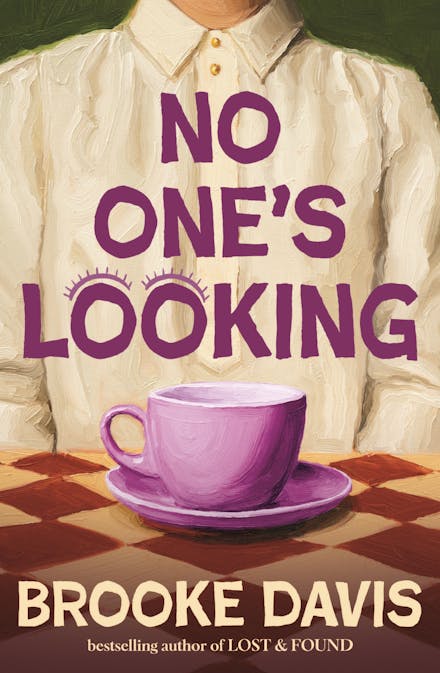
From the internationally bestselling author of Lost & Found comes a comedic and uplifting novel that brings home the secret rage of women through a lively suburban family and the brawling love between two middle-aged sisters - who no one is looking at anymore.
Latest news

Read an extract from The Waiting Place
Dive into this dazzingly good YA!

Favel Parrett's One for Sorrow Tour
Meet award-winning author Favel Parrett as she tours Australia to promote her new book One for Sorrow

The Richell Prize Shortlist 2026
Announcing the shortlistees of The Richell Prize 2026

Book Club Questions for No One's Looking

Hachette Haunts
Our Halloween reading guide!
Find a book you'll love, get our newsletter
Hachette Australia acknowledges and pays our respects to the past, present and future Traditional Owners and Custodians of Country throughout Australia and recognises the continuation of cultural, spiritual and educational practices of Aboriginal and Torres Strait Islander peoples. Our head office is located on the lands of the Gadigal people of the Eora Nation.

This site is protected by reCAPTCHA and the Google Privacy Policy and Terms of Service apply.
© Hachette Australia, All Rights Reserved · Site by Chook