


Tanya Bretherton discovered the jazz age was not all glitz and glamour when researching her new book THE SUITCASE BABY.
The fascination with true crime stories is not new.
I had always assumed that the morbid fascination with violent and tragic true crime stories was a social trend that emerged later in the twentieth century. Some argue that the publication of Truman Capote’s In Cold Blood in the mid-1960s represents the birth of the true crime genre. Others argue that the growing interest in criminology and profiling has fuelled public interest in true crime. Sensationalist news stories that used the term ‘serial killer’ for example emerged post-1970s, and soon became part of mainstream vernacular. For these reasons I had always thought true crime was a very recent genre of entertainment, and perhaps part of modern society’s attempt to understand the darker parts of the human psyche.
During the process of researching The Suitcase Baby I began to realise that although the term ‘true crime’ may not have existed in the 1920s, public delight in criminality and the macabre has existed for a very long time. Stories which provide an overly detailed account of very gruesome criminal events filled the pages of 1920s newspapers, but also news reports going back into the nineteenth century as well. Newspaper editors have always devoted a huge amount of copy to the reporting of criminal events and the moral and legal implications arising from them. Murder and mayhem certainly sells newspapers today, but the same could also be said two hundred years ago.
Sydney’s Suitcase Baby experience was not unique
There is no doubt that Sarah’s story is shocking. The act of a mother killing a child is unthinkable - a taboo. During the process of researching The Suitcase Baby, I was even more shocked to discover that Sarah’s child was not alone. Many women made the terrible decision to murder and discard their babies not just in the 1920s, but in the decades preceding. Sarah’s tragic decision may have been uniquely sad, but it was certainly not unique in statistical terms.
The problem of infanticide was also not unique to Sydney. Dead babies were discovered in public places across all of the metropolitan capitals and in regional country towns too. Suffocated and strangled newborns were found in the poorest parts of cities and it was often assumed that economic desperation had led women to do the unthinkable. However, many dead babies were also found in the affluent suburbs. The shame and disgrace faced by women with illegitimate children was universal.
Other eerily similar patterns are associated with infanticide and the disposal of children at the turn of the twentieth century. Water often featured. While in Sydney, babies may have been thrown into the harbour, in Melbourne they were found on the banks of the Yarra. Public transport also often played a role. In Sydney, murdered newborns were found on trains, while in Melbourne and Adelaide they were found on trams and at tram stops. Most shocking of all, dead children were often found by children. Because many babies were discarded in public places (parks, vacant tracts of land between buildings, and bushland), children were often the ones to discover the bodies of babies. Children, in search of adventure and keen to explore the city in the early morning, often stumbled upon dead babies wrapped in newspaper, in petticoats or towels, who had been secretly disposed of under cover of darkness the previous evening.
The jazz age was not all glitz, glamour and Gatsby
While researching The Suitcase Baby I discovered that I had a lot of preconceived ideas about the 1920s and the jazz age which were not particularly representative of the experience of most women. When I think of jazz age I see flappers. I imagine women asserting themselves and challenging social conventions – particularly those surrounding sex. Stories I had read about jazz age Sydney prior to researching The Suitcase Baby seemed to affirm these very stylised ideas about the hedonism of the inter-war years. The 1920s in Sydney also produced some very famous women criminals. During the infamous razor gang wars of the inner city, women emerged as key protagonists. Kate Leigh and Tilly Devine were strong, gutsy and brassy broads – seemingly unafraid of the consequences of flouting social convention. Sarah Boyd’s story in The Suitcase Baby presents us with a very different narrative of jazz age life for women. To look at a photo of Sarah it is all too clear there is very little fight left in her.
For men who engaged in sex outside of marriage in the 1920s, the social and economic risks were comparatively low. For women, the stakes were higher. If a pregnancy resulted, men could simply ‘shoot through’ and although they could be legally charged with desertion, they had to be found first. By comparison, women faced a much tougher set of immediate social and economic consequences. Women who attempted to live openly as single mothers very quickly became destitute because they were shunned by employers, family and society. In the absence of any form of social welfare support and without child care, women faced grim prospects indeed.
The research I undertook for The Suitcase Baby was fascinating because it became about so much more than just one woman’s story. Sarah took risks and she challenged social norms surrounding marriage and family but she paid a huge price for it, and so did her children. Unfortunately, many women at the time also found themselves in similarly terrible, and ultimately tragic predicaments.
Tanya Bretherton has a PhD in sociology with special interests in narrative life history and social history. She has published in the academic and public sphere for twenty years, and worked as a Senior Research Fellow at the University of Sydney for fifteen years. THE SUITCASE BABY is out now.
-
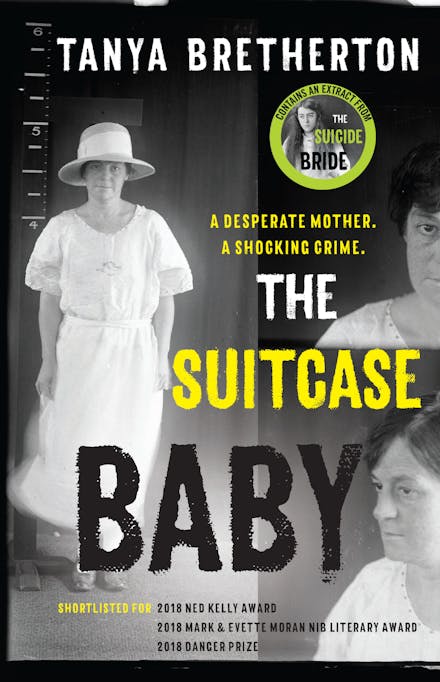
SHORTLISTED FOR THE 2018 NED KELLY AWARD, DANGER PRIZE AND WAVERLEY LIBRARY NIB
SYDNEY, 1923: a suitcase washed up on a harbourside beach reveals its grisly contents - and from there, an extraordinary story unfolds.
Latest news

Start Reading No One's Looking
Read an extract from No One's Looking, a comedic and uplifting novel from bestselling author Brooke Davis. Out October 13 2026!

Hachette Memories of Lost & Found
Our staff share how special Brooke Davis' debut was - we’d love to hear your memories too!

Brooke Davis' Letter to Booksellers
The lovely Brooke, a bookseller herself, checks in with her colleagues across Australia to say a big hello.

Alice Oseman is coming to ANZ!
Information on Alice Oseman's - author of Heartstopper - trip to Australia and New Zealand.

Q&A with Penny Sunday
Meet Aussie dark romance author Penny Sunday!

Read an extract from The Wretched Divine
From the bestselling author of Belladonna
.png?w=440&h=247&fit=crop&auto=compress%2cformat&dpr=2)
Ashleigh Barton's Letter to Readers
Ahead of Eighty-Nine Questions for After, Ashleigh shares her thoughts on why sad books are so important for kids.

Read an extract of True Crime
Start reading Patricia Cornwell's thrilling memoir

The Richell Prize Opens 2026
Announcing this year's round of The Richell Prize

Mum's Shelf, Sorted
Happy Mother's Day!

Read an extract from The Chateau on Sunset
Read the new book from bestselling author Natasha Lester

Read an extract from Rat Daniels
Dive into this unforgettable coming-of-age story from a stunning new voice in Australian fiction

Book Club Questions for Margaret, Are You Leaving?
We hope these questions help guide your book club discussion for this heartfelt novel. We’ve done our best to avoid spoilers, but don’t read these questions unless you’ve finished Margaret, Are You Leaving? – you don’t want to risk ruining any reveals!

Welcome to the World of Donovan Bixley
Entertain the kids at home

Read an Extract from Rebirth: A Love Story From the Depths of War
Antoun Issa powerfully captures his mother's true experiences of love, heartbreak and new hope during the violence of civil war.

Celebrating our CBCA 2026 Notables
The Children's Book Council of Australia's 2026 Notables list has been announced!

Meet J.P. Pomare and Candice Fox on tour across NSW
J.P. Pomare and Candice Fox are teaming up for a scintillating series of events across regional NSW. Hear J.P. discuss his highly charged thriller The Gambler and Candice discuss her addictive new novel Redbelly Crossing.

Natasha Lester On Tour | 2026
Meet bestselling author Natasha Lester as she tours Australia

Book Club Questions for The Gambler
We hope these questions help guide your book club discussion for this incredible thriller. We’ve done our best to avoid spoilers, but don’t read these questions unless you’ve finished The Gambler – you don’t want to run the risk of ruining any reveals!

J.P. Pomare Book Tour 2026
J.P. Pomare will tour Australia to discuss his highly charged new crime thriller, The Gambler, marking the start of an electrifying new series featuring PI Vince Reid.

Supporting our Adelaide Writers Week authors
A guide to our authors

Read an extract from Good People by Patmeena Sabit
A kaleidoscopic, urgent narrative, told through the chorus of voices surrounding the Sharafs, Good People is a riveting, provocative and unforgettable story of community, family and identity.

Read an extract from Finding Her Edge
A swoony YA sports romance coming soon to Netflix

Read an extract from The Swan's Daughter
Stardust meets Uprooted with a fairytale twist in this standalone fantasy.
Find a book you'll love, get our newsletter
Hachette Australia acknowledges and pays our respects to the past, present and future Traditional Owners and Custodians of Country throughout Australia and recognises the continuation of cultural, spiritual and educational practices of Aboriginal and Torres Strait Islander peoples. Our head office is located on the lands of the Gadigal people of the Eora Nation.

This site is protected by reCAPTCHA and the Google Privacy Policy and Terms of Service apply.
© Hachette Australia, All Rights Reserved · Site by Chook