


What inspired you to write Gunnawah?
I’ve always wanted to tell the story of those wild, heady 1970s days in Australia’s Riverina, of the large cannabis trade and the subsequent fall-outs from that - I’d known those real-life stories for most of my life. I was also fascinated by the huge social and cultural change that happened in Australia during that time as well, and realised it largely hadn’t really been written about within a work of fiction. I knew I wanted the story to have a strong quirky humour tone to it as well because when you know about those times, you realise they really were outrageous. When I was asked by a publisher in 2022 to write a non-fiction book, I said I probably wasn’t interested but that I did have a great novel brewing inside me and that it had been in there for many years. She encouraged me to sit down and write it instead of just thinking about it – so I did.
Are there any pieces of pop culture, trends, treats or objects from the 1970s you’d love to bring back into vogue today?
When I was researching 1974, I spent a lot of time reading newspapers of the time – both the larger city-based daily newspapers and the local country newspapers. That way I wasn’t caught up in official versions of Australian history recorded in books (which I’d largely read in my uni days) and could sniff through the hidden cultural items of the times. I really wish we could get Gough Whitlam back, his fearlessness was astonishing. I’d love to see a group called Masters Apprentices back again and Aussie pub rock music which seemed to thrive in that time. I also discovered the trend for hideously garish wallpaper (yuk) and lava lamps (love), something called “treads” (shoes made from old car tyres, don’t even ask) as well as chocolate caramel Mates, which I found supplied on an online retro lolly shop and didn’t realise were just Fantales, but anyway, I ate the entire bag.
Who are some of your favourite crime writers?
Oh my goodness, who isn’t a fave of mine? True crime writers like Debi Marshall, Helen Garner, Andrew Rule and John Silvester are faves. Also, novelists like Carl Hiaasen, Patricia Cornwell and Peter Temple, Philip McLaren, Janet Evanovich, Michael Rowbotham, Margaret Hickey, Dinuka McKenzie, Jane Harper and the classics of the genre like Ruth Rendell and Elmore Leonard. I could go on and on, but I don’t want people thinking all I do is read crime books.
What book is at the top of your to-read pile?
I’m currently reading Gough Whitlam: His Time by Jenny Hocking (because I’m busily writing the sequel to Gunnawah) plus Rural Dreams, a collection of short stories by Margaret Hickey and Three Boys Gone by Mark Smith. Queued up on my kindle are; Highway 13 by Fiona McFarlane and Jilya by Dr Tracy Westerman.
What do you hope readers take away from Gunnawah?
That a crime novel can be more than just solving a crime, it can also be a full and compelling story about characters and their lives and what binds people together – and it can also be hilarious, just like life itself. I also hope people realise that young rural women can be as tenacious and fierce and intelligent as their city counterparts and that rural people’s skills and intelligence are the same as everyone else’s – they just happen to live a lot further away.
Learn more about Ronni and the book here!
-
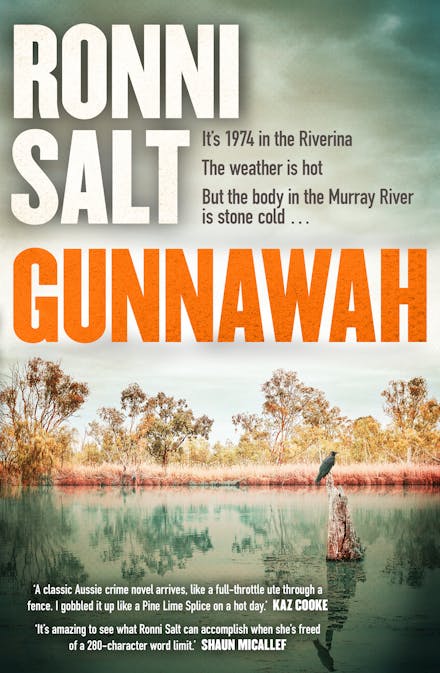
It's 1974 in the Riverina
The weather is hot
But the body in the Murray River is stone cold . . .
A captivating and compulsive crime thriller about guns, drugs and a young woman dead on the money
Latest news

Read an extract from The Waiting Place
Dive into this dazzingly good YA!

Favel Parrett's One for Sorrow Tour
Meet award-winning author Favel Parrett as she tours Australia to promote her new book One for Sorrow

The Richell Prize Shortlist 2026
Announcing the shortlistees of The Richell Prize 2026

Book Club Questions for No One's Looking

Hachette Haunts
Our Halloween reading guide!
Find a book you'll love, get our newsletter
Hachette Australia acknowledges and pays our respects to the past, present and future Traditional Owners and Custodians of Country throughout Australia and recognises the continuation of cultural, spiritual and educational practices of Aboriginal and Torres Strait Islander peoples. Our head office is located on the lands of the Gadigal people of the Eora Nation.

This site is protected by reCAPTCHA and the Google Privacy Policy and Terms of Service apply.
© Hachette Australia, All Rights Reserved · Site by Chook