


Start reading The Gatsby Gambit, a glittering murder mystery by Claire Anderson-Wheeler.
The world's most beloved literary characters. The gilded opulence of the Roaring Twenties. A murder that scandalises high society. And a clever young woman of unusual persistence ... Be ready to re-think the world of Gatsby. Read an extract below!
Chapter One
The train gathered speed as the sea finally blazed into view, and Greta Gatsby fiddled with the crumpled letter in her lap.
“Next stop, Great Neck. Great Neck!”
The conductor strode through the corridor, knocking on compartment doors. Great Neck was the first stop on Long Island; though the train would continue through a smattering of resort towns all the way to Port Washington, Greta would not be on it. She was bound for West Egg, the secluded little haven some four miles north of here where her brother, Jay, had made his home. Their home: seven years younger than her brother, Greta had lived under Jay’s guardianship since their parents had died fifteen years ago.
You couldn’t deny it was a remarkable turnaround of fate. They’d been born poor and orphaned early. All she’d had was Jay, and then he’d gone off to the front, and Greta, to live with their dour Aunt Ida. Lonely years, indeed. But Jay had always said everything would change once he was rich, and though others might have thought him a dreamer, he’d been right. He had a head for strategy, it turned out. Though he didn’t much use the marble chess set in the library, he knew its rules. Greta had noticed how people never expected her brother to be shrewd in business—he had the soul of a dreamer, and therefore they underestimated him— but since childhood Greta had known her brother was special. Even so, she’d never expected him to be quite so successful.
“The art of the gambit,” he’d told her once, years ago. She’d been confused; chess was hardly gambling.
“Gambit,” he’d corrected her. “It’s a tactic. In chess it means sacrifice: you
lose something to gain something.”
At the time, she hadn’t thought much about the sacrifice part. But sometimes now she wondered exactly what Jay had lost— what they had both lost, perhaps—in order to get where they were.
“Going somewhere nice?”
A young man had entered the compartment shortly after Grand Central. He was the sole other occupant of the enclosed space and the hint of impropriety in this was faintly thrilling, even if the same could not be said for the young man himself, who had been sniffing energetically the whole way from Manhattan, and on whose lapel a souvenir of lunch was prominently displayed. He looked at Greta expectantly, awaiting her answer.
“Home,” she obliged. Somewhere she’d longed to be many times these past few years.
As soon as he’d had the money for it, Jay had sent her off to a fancy boarding school stocked with Mayflower types, and then to an even fancier “finishing school” for a couple of years. Jay wasn’t a snob, but he detested being looked down on, and was determined that Greta would escape the stain of New Money. For her part, Greta had begged him, if further learning was to be involved, to send her to a real university, one where she might learn something about the world besides the art of watercolor and how to recite poetry, but to no avail. She’d done her best to learn about the world all the same, burying her head in a science book or a newspaper as often as in her beloved mystery novels. Her father had been something of an amateur scientist, and her mother a pragmatic woman who made balancing the household accounts look like child’s play. They had always agreed on one thing above all, which was that a mind was a terrible thing to waste.
Greta wholeheartedly agreed, but she also felt that life was a terrible thing to waste. Happily, this summer, at the grand old age of twenty-one, Greta Gatsby had finished her education for good and was coming home to stay. It was absolutely thrilling and a little intimidating. She hoped for freedom, and feared for a new set of restrictions— the world Jay had bought them entry into had already shown itself to be heavy with codes and rules—but escaping from the Academy was an incontrovertible joy. Whatever the real world held for her, she decided, it had to be more invigorating than how she’d spent these last years of her life.
The young man opposite gave another protracted sniff—he really was exerting himself with this one—and for both their sakes, Greta felt moved to offer him her handkerchief.
“I’m all right.” He waved. “You dropped your letter.”
She demurely retrieved the crumpled paper from the floor and tucked it away. She knew all its news by now anyway. Chiefly, Jay had wanted to alert her that his friends Tom and Daisy Buchanan would be at the house upon Greta’s return—apparently, they had been staying there for some weeks while their own stately pile, in the tonier locale of East Egg, underwent some repairs.
The Buchanans had been a fixture in Jay’s life for years now, which was not an alliance Greta particularly rejoiced in. She was used to them traipsing in and out of Jay’s house during the summer when they weren’t on the Côte d’Azur or in Monte Carlo or up in Newport or the Cape, and Greta knew her brother considered Daisy to be the epitome of graceful womanhood and a perfect role model for Greta. She supposed Daisy didn’t care much either way about Jay’s mostly absent little sister, and certainly Greta had never considered Daisy and herself to have much in common. Jay, however, persisted in thinking that the two held a high sisterly regard for each other, and Greta had long learned that when Jay believed something, he’d believe it in the face of all evidence to the contrary.
“Great Neck!” the conductor called again, now with an air of finality, and the train began to slow. Greta stuffed the letter back in her bag and gathered her things, holding on to her new cloche on the seat beside her as it made a bid for freedom. The hat was a beautiful pale green shade, newly purchased upon Greta’s graduation from the Academy, and she thought it looked rather dashing with the brand-new bob she’d just had done. Jay would hate the bob, of course—It’s rather unfeminine, Gigi, isn’t it?— but Greta thrilled every time she ran her hand through her hair and felt that blunt, shorn edge. Like everything else today, it seemed to hold a promise of freedom.
There was a hiss and a final lurch, and the train came at last to a standstill. Her nasally companion tipped his hat to her, and Greta dismounted in the churn of slammed doors and raised voices.
“Miss Gatsby? Miss Gatsby!”
A young man was making his way across the platform toward her, clad in the smart, gold- trimmed livery of the Gatsby house, but Greta didn’t recognize his face.
“Miss Gatsby? I’m the new chauffeur. Bill Richardson.”
She frowned. Jay had sent the chauffeur? And what had happened to Silas, the old one? She’d rather hoped her brother would be here to greet her in person.
“Here, miss—a note from Mr. Gatsby.” Bill Richardson fished a paper out of his pocket and passed it over.
Terribly sorry, Gigi, it read, in Jay’s familiar scrawl. I came in to get you with Daisy, but the train was so delayed and she was expiring with the heat, I had to ferry her home. Bill here is the new chap.
Bill smiled at her. Under the peaked cap, he had sandy hair and a freckled, narrow face.
“Your brother showed me a photograph so I’d be sure to recognize you. And if I may say, you’ve not changed much, miss, except for the hair.”
Greta allowed herself a small grin.
“Yes, it’s rather a new feature. I’m not sure that it will be terribly well received back home.”
Bill nodded.
“Part of the appeal, miss?”
Greta smiled. Bill was a wit, evidently.
The station master’s whistle blew. The train pulled out, and Greta let Bill relieve her of the small valise she carried.
“That’s it?” he said.
“There’s an awfully large trunk coming on the slow train in a few days,” Greta admitted, and Bill chuckled.
“A lady never travels light, so I hear.”
Perhaps Jay hadn’t entirely failed to make a lady of her, then.
In the parking bay, she was greeted by the sight of Jay’s beloved automobile, that primrose-colored Rolls Phantom he’d bought in a particularly indulgent spree. Subtlety had never been her brother’s strong suit, Greta reflected. The heavily muddied undercarriage was a surprise, though: usually Jay insisted on it being kept pristine.
“Had a lot of rain?” she asked, as Bill hoisted up the valise.
“Pouring nonstop the last few days. Your brother and his guests have been feeling quite housebound. But it’s cleared up nicely for your arrival.” Bill swung open the Phantom’s heavy door for her, and Greta stepped inside with a feeling of giddiness. Buchanans or no Buchanans, nothing was going to interfere with her pleasure at being back on the island. Jay had chosen well, making his home here. Greta had once thought that her brother would return to North Dakota once he’d made his fortune, and settle there. After the war, though, it was clear he’d set his sights on the East Coast. The world was fresher up here, the air as crisp as dollar bills. The people were crisp, too, Greta had noticed: brisk and cliquish and often frosty. But Jay seemed either not to notice that part, or not to care.
Bill installed himself in the front seat and the Phantom purred to life. They chugged out of the station onto a road busy with automobiles and bicycles, men in golf caps or trilbies, women carrying baskets . . . but soon the narrow streets with shops and houses gave way to roads with trees and ditches, and sun coming through a canopy of leaves overhead.
“Are you a fast driver, Bill?” Greta called from the back. “You rather look as though you might be.”
He didn’t seem to mind the goading. “If you’re eager to be home, Miss Gatsby, I’ll endeavor to oblige.”
He was as good as his word, and as he fearlessly took the corners on the country road, Greta put her head out the window, and let the wind rush through her newly shorn hair and tickle her scalp. They passed a brick schoolhouse, a white-painted church, a corner where a small boy chased a dog. Greta thought she could already feel that fresh, bright air of Manhasset Bay, the glory of West Egg. She pictured it now: the long lawns that led down to the water and to the Gatsbys’ private dock where their boat, the Marguerite, bobbed gently in the waves. The summer nights when fireflies would congregate and the green light from the Buchanans’ dock winked at them from across Manhasset Bay. The window seat in the living room where she’d passed many summer hours ensconced, deep in one of her mystery novels. She’d ordered that new Agatha Christie book only last week from Dauber & Pine, that lovely little place just off Manhattan’s Book Row; perhaps it would have arrived by now.
And perhaps this summer might give her an opportunity to spend some real time with Jay. Maybe it was the gap in years between them that made him seem so . . . distant, sometimes. Or perhaps the rupture he’d made with their past? He was always so immersed in his world of parties and friends, being the man they had come to know instead of the boy Greta remembered him being. He was as kind as ever, as generous as ever, but he was so determined not to look backward . . . and sometimes Greta wondered if she, too, might be part of that backward.
Bill tooted the horn, rounded the bend, and there were the tall black gates rising up in front of them. Bill unlocked them, then got back in and coaxed the Phantom gently up the incline. One more corner, and the Gatsby mansion emerged out of the trees. Excess reigned in every room of that house, but nothing could spoil its stately simplicity as it rose up before her now, the glorious white stone bathed in the afternoon light, the leaded windows reflecting fiery gold. Greta felt a small bubble of joy rise up in her chest.
Home.
-
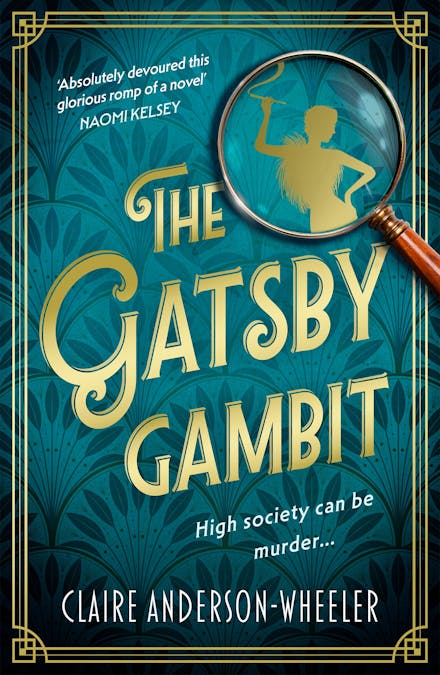
At your peril, you are cordially invited to summer at the Gatsby West Egg Mansion, with the most illustrious - and the deadliest - guest list. When one of the guests is murdered, Greta Gatsby is on hand to investigate...
Latest news

Read an extract from The Waiting Place
Dive into this dazzingly good YA!

Favel Parrett's One for Sorrow Tour
Meet award-winning author Favel Parrett as she tours Australia to promote her new book One for Sorrow

The Richell Prize Shortlist 2026
Announcing the shortlistees of The Richell Prize 2026

Book Club Questions for No One's Looking

Hachette Haunts
Our Halloween reading guide!
Find a book you'll love, get our newsletter
Hachette Australia acknowledges and pays our respects to the past, present and future Traditional Owners and Custodians of Country throughout Australia and recognises the continuation of cultural, spiritual and educational practices of Aboriginal and Torres Strait Islander peoples. Our head office is located on the lands of the Gadigal people of the Eora Nation.

This site is protected by reCAPTCHA and the Google Privacy Policy and Terms of Service apply.
© Hachette Australia, All Rights Reserved · Site by Chook